Friday, 22 March 2013

mapping memories


Done and dusted, almost! I finally sent off the retouched, reworked, resized, highlighted, airbrushed, copied and proofed artwork for printing yesterday. In a month from now I should be getting the composite image made from 52 photographs, printed on 3 sheets of formica. These will then be bonded onto three table tops furnishing a common room at the Lewisham Hospital. This will be the culmination of my involvement in the Little Boxes of Memories project, led by Entelechy Arts in partnership with the Museum of London and the hospital. See previous post art for health: remembering and forgetting for more writing on this.


The design was inspired by stories of four participants I worked with at the hospital. A patchwork of words, images, flowers, objects and materials all collaged together, it maps out their personal accounts of London and other places. The design weaves elements of interconnected narratives and memories of celebration, hope, love, loss, travel, passions, transformation and change, aiming to prompt further sharing and reflection amongst visitors and patients.


Thursday, 21 March 2013

the new age of Wicca


Earlier this month the creative agency Wicca re-launched their website, showcasing a new extended stable of artists. It was great to see the range of works featured in each of the artist’s portfolios, and also the selection of images chosen by Wicca of my own work. What all their artists have in common is a strong foundation in craft and making, whether specialists in 3D production, art direction, design or illustration. It was a treat to read the bio they wrote about me, not least because for once I didn’t have to write the copy myself.  So, blatantly indulging myself, I'll share it with you below:


Weaving, Basketry, Material ‘Hacking’

Shane's work draws inspiration from craft traditions and processes. This sees him create visual narratives using materials and skill-sets as varied as needlepoint, basketry, weaving and sugar craft. A true expert in the field of craft practices, Shane can take everyday objects, and the simplest of materials and 'hacks' them to create the visually spectacular. 


At its core Shane's work is rooted in ideas of ecology and the reuse and recycling of material. His fluency with materials and processes allow him to play with scale in his work, from enormous pieces covering the central atrium of the V&A to smaller scale experiments with grasses, sugar and balloons. Shane has exhibited work worldwide. He lives and works in London. 


Clients include: Jupiter Artland, Scotland, Museum of Arts and Design, New York, Swarovski, Scottsdale Museum of Contemporary Art, Arizona, Powerhouse Museum, Sydney, Federation Square, Melbourne, Sydney Design 2011, Royal Shakespeare Theatre, Stratford-Upon-Avon, Bloomsbury Publishing, Nottingham Castle Museum and Art Gallery, Dovecot Studios, Edinburgh, Siobhan Davies

Needless to say I am really looking forward to working with them. For more info on the agency and Wicca artists, click here.


Monday, 4 March 2013

flights of fancy


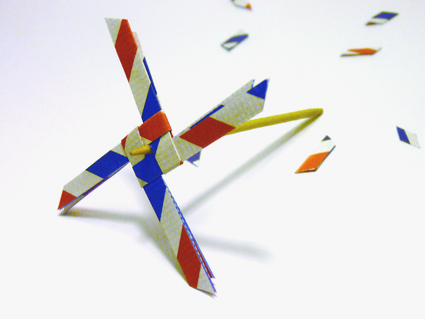
While sourcing materials to produce artwork for a commission at the Lewisham Hospital, I was very happy to see that when I searched for suppliers of chevron border envelopes, three of the four images that first came up were of my dailymades.


I have repeatedly been drawn to working with patterned envelope papers over the years. I used them as early as 2002 in a sound installation for Danielle Arnaud at the Museum of Garden History, and in another sound piece created for my first solo exhibition at MK gallery in Rotterdam. I have included  them since in the graphics on my website, and I like to think that I possibly have the largest collection of patterned envelope papers in the world.  Entering the collection in the Guinness Book of Records has been on my to do list for over a decade now and writing this will, hopefully, prompt me to do something about it.


Amongst all the envelopes in my collection, there is something I find particularly compelling about the chevron border airmail envelopes; they travel faster and longer distances than other envelopes, criss-crossing the globe like migratory birds, and weighing no more than some of these avian species either. In an age where most correspondence is done via email, chevron bordered envelopes convey a sense of romance and the exotic. Though cheap, readily available and instantly recognisable, they are full of the promise of distant places. For me, this sums up their enduring appeal...


Thursday, 28 February 2013

potty for pots!


Mud, glorious mud! I’ve been rediscovering the pleasure of working with clay and successfully throwing my first ever pots in the process. Why? How? It happened like this... I was teaching on the 3D Design course at Camberwell College, speaking to Grace, a final year student who has been working on a series of pots with wooden handles pierced through them and secured with leather and bark lashings. Lovely work! I told her I’d never been able to successfully throw anything on a potter’s wheel.  My last failed attempts were some 20 years ago at least, after which I gave up. After our chat I found myself in the ceramics workshop and decided, rather suddenly but with determination, to leave my (hurt) pride behind and have fresh go at the wheel. These are the results, and I now officially have the bug for mud!


I lost the base of my third throw after badly damaging it when sliding it off the wheel - a tricky manoeuvre, especially when you like throwing ‘wet’ like I do. Rather than recycling the clay, I removed the base completely and squashed the uneven rim to form an oval, then dipped it in slip and transparent glaze.


This did prompt a few comments in the ceramics room. What use is a pot without a base? Well, my feeling is if it’s good enough to look at, that is purpose enough for me! Besides, with a base each, how would these three fit so snuggly together? Apart from loving wrestling with mud, all this has reminded me of an old passion of mine, the collection of pots, bottles and vases painted by Giorgio Morandi. So, these first ever pots of mine are my own private homage to him, with thanks to Grace as well of course.


Monday, 18 February 2013

the ABC of architecture

the birth of architecture - wattle without the daub

A winter bug prevented me from going coppicing at The Ranges in Shepperton a few Sundays ago.  Big shame! It was a beautiful day, and I had big plans too!  On my last visit I busied myself with cutting the last couple of year’s growth of Salix vinimalis with other volunteers.  Sally Fletcher who owns the land and runs the project informed me on that occasion she planted around 20.000 willlow cuttings on the site 12 years ago, and this is what it looks like now below after annual coppicing.


During that cutting session I planted my own willow from the freshly cut prunings  - see top picture.  I had in mind the first buildings ever made, essentially baskets - sticks woven around stakes in the ground to create pens. The architect and historian Gottfried Semper in his essay ‘the four elements of architecture’ considered the relationship between weaving, textile and architecture, noting that the first architectural structures made by man defined space for the purpose of defence and protection.  Working this ancient craft I laid the foundation for a circular 'yurt' shaped construction, with the live plant standing where the hearth would be, my own personal take on the circle as a symbol of unity, wholeness and the infinite.

Going to The Ranges again would have given me the opportunity to add to the single miniature ‘dwelling’ and possibly added to it towards the making of a small hamlet.  Oh well, chose remise as they say!  I shan’t be leaving it too long though as spring is near approaching and the plants will need this time to root before going into leaf if they are to grow into healthy specimens.  I am a novice at growing willow but this much I know! I’ll keep you posted shortly on future willow works.  In the meanwhile, this is to be remembered:

A is for architecture
B is for basketry
C is for coppicing

The three practices seem indeed to have been related since the origin of time.


Saturday, 12 January 2013

memos to myself


Out with the old, in with the new! The New Year calls for a new brief, a new manifesto! There will  only be one set of rules for making my dailymades, it’ll be THE ONLY MANIFESTO…

ONLY take a day maximum to make something
- the clue is in the title of the series of works
ONLY use found, foraged or recycled materials
- be a producer not a consumer
ONLY use the most rudimentary tools
- hi tech is good, lo tech is better
ONLY work with cheap materials
- the value is in the making
ONLY make things once
- variation is better than repetition
ONLY make sense of things through repetition
- either that or improvisation
ONLY make things spontaneously
- a variation of the previous rule
ONLY record the making process in my head
- to make reproducing more revealing
ONLY reveal the art through criticism, not backed up by it
- this one is after Robert Benjamin
ONLY make work according to these rules
- like boundaries you've got to have them
ONLY stick to these rules until you decide to change them
- the only truly sensible way to work


notebook and glue
dailymade #130110

Saturday, 5 January 2013

horns of (little and) plenty


stripped and split sycamore
dailymade #120705

Going round in circles comes really naturally when I’m making. This is not altogether surprising as I commonly use basketry techniques for producing my dailymades. Reviewing a year's work I now realise just how many of these are circular, conical and horn shaped.

plaited paper
dailymade #121021

My aim is to make sculptures rather than baskets though. These constructions rarely have bases, or handles, and are often made from ephemeral materials. I'm interested in assembling and manipulating materials through the process of weaving. Tying the ends of flexible lengths of materials together is a usual starting point and the final shape, largely determined by the nature of the materials themselves, is achieved by working these through improvised or repeated actions. Striking the right balance between the two actions is how the potential in the work is revealed, often in mysterious and surprising ways.

plaited paper
dailymade #121214

With repetition comes certainty and the accidental ends up controlled. When a pattern emerges, this is my cue to stop weaving; the suggestion of a pattern is enough. Repeatedly ‘looping the loop’ is unnecessary because at this stage the open-ended spirals of these woven cornucopias are already full of promise, tempting you to look closer.

assembled cherry prunings
dailymade #120226

plaited phormium leaves
dailymade #120518

coiled modelling balloons
dailymade #120516

woven elder, sycamore bark and grass
dailymade #120610

plaited toilet paper
dailymade #121019

corded and twined napkins and plastic forks
dailymade #120213

coiled paper spills and paper clips
dailymade #120124

Sunday, 23 December 2012

plaiting plastic fantastic


Plastic these days has a bad name, and for all the right reasons.  It doesn’t stop me loving it though; colour, strength and versatility are characteristics that attract me to these polluting synthetic polymers. Plastics could easily be my guilty pleasure if I didn’t keep a tight check on it. That said, I’ve been doing my bit for the environment this week by making use of old plastic bags for dailymades.  Inspired by my recent workshop at the Museum of London (see weave and wealth), I rekindled my passion not only for plastic but also plaiting.

plaited plastic bags
dailymade #121221

I all too often realise I’ve forgotten how to make something as I attempt to recreate it and therefore need to improvise which inevitably leads to different outcomes every time.  Necessity truly is the mother of invention! Allowing myself to forget is somewhat planned however, as the possibility of creating new everytime is is too good an opportunity to miss.

So, expect to see more variations of these woven items in days to come on dailymades as I’ll indulge myself over the festive season plaiting plastic fantastic!

plaited plastic bags
dailymade #121220
for more details on plaited baskets and projects
using recycled materials, see
Practical Basketry Techniques


Saturday, 15 December 2012

weave and wealth


paper, chinese ink and tea

With the advent of the first baskets being made, humanity took a giant leap forward; goods at last could be stored, exchanged and traded. Honouring this history in the context of a workshop planned at the Museum of London in Docklands, I decided to focus on the collection documenting the pool of London as one of the world's first major trading centres, a city that became a ‘warehouse of the world’ between 1830 and 1939, as ships brought in exotic commodities from the far east and the then-called ‘new world’. 

paper, chinese ink, herbs and spices
dailymade #121210

The workshop consisted of plaiting baskets (a technique largely imported from Asia) using layered paper strips and tissue paper.  The strips were painted, then filled with the participants’ own blend of spices, herbs and seeds to create fragrant containers for them to take home. As the fragrances will eventually fade, I suggested the baskets could be buried in the ground or in containers so to allow the seeds to germinate.

The containers produced over the course of the one afternoon were symbolic items celebrating London’s rich history and cultural diversity.  Sadly I got too busy to take pictures at time. These of course couldn't have conveyed the wonderful aromas produced as the spices and herbs were mixed, ground and added to the baskets, so below is a poem by John Masefield, part the museum display, that might go some way in bringing smells to mind:

You showed me nutmegs and nutmeg husks
Ostrich feathers and elephant tusks
Hundreds of tons of costly tea
Packed in wood by Cingalee
And a myriad of drugs which disagree
Cinnamon, myrrh and mace you showed
Golden paradise birds that glowed
More cigars than a man could count
And a billion cloves in an odorous mount
And a choice of port wine from a bright glass fount
You showed me, for a most delightful hour
The wealth of the world and London’s power. 

Monday, 26 November 2012

reuse / remake / reinvent


Making new from old… This is what some 130 Foundation students specialising in Design at Camberwell College of Arts were assigned to do, when using old pieces of furniture, taking them apart and using the pieces to create something new. Deconstructing is often the best way of finding out how  things are made, and with this brief students got the opportunity to experience first hand how to identify elements of design from the structural to the functional, how materials were combined and how the furniture was constructed.  While teaching them I for one got to refresh my memory on some technical jargon and certainly won’t be forgetting the difference between a dado and groove joint in a hurry! The whole project amounted to a cut and paste exercise in 3D, with making leading the design process.


The best part, aside from the final display of outcomes illustrated below, was when students traded and exchanged parts during a bric-a-brac / flea market type event half way through the project.  Not everyone got what they wanted, some lost almost all they had brought, but with this new opportunities for thinking and making were made possible as an ad-hoc element was thrown into the brief.


The potential these works have lie in their open ended functionality: a constructed piece might become  a chair when positioned one way, a table when used on its side, or a piece of architecture when it's  turned upside down. Their practicality will ultimately be negotiated between the maker and the user. Meanwhile, the 3D workshop area with all its tools and equipment has become less of an alien environment for the students, a must for future designers.