Friday, 16 November 2012

now we are one


Dailymades is 1 today! That’s 365 posts in the last year, one sculpture made everyday.  I’m surprised I’ve got this far with the project, and there’s no sign of stopping anytime soon either…

My aim, as with weeklyweaves, was to make sense of my interests in making and weaving with relation my own sculptures, installations and performance work. I aimed to make my practice a daily activity working with everyday materials and techniques.

From this a pattern of producing archetypal/symbolic shapes has emerged, circles for example, and making has become automatic, almost instinctive. Does it all make sense yet?  Yes and no. As with any research, one question leads to many more, and the answers (as well as inspiration to make more) are to be found amongst all of these.

dailymade #121108

One of my own personal favorite outcome meanwhile is the one illustrated above, produced last week and made from lollipops. Below is another survey, that of the 10 post popular posts since the blog began. Thank you for reading and following!

dailymade #120714

dailymade #120901

dailymade #120905

dailymade #120102

dailymade #120611

dailymade #111116

dailymade #111213

dailymade #120531

dailymade #120722

dailymade #111127

Tuesday, 30 October 2012

the secret of youth


Left my foraging ways behind in favour of urban forestry last weekend as I collected lime wood for making what I’m hoping will be a series of kinetic sculptures.  It will involve balancing wooden spirals (larger scale versions of the one pictured below) on an axis and have the wind spin them. More on this on a future post on this blog, meanwhile back to pruning, or rather pollarding…  


My good friend Marcelo, who I’ve worked with on the Weaving Time Machine sculptures helped me collect the wood that Jack (pictured up the tree) felled with his handy chain saw.  It was impressive to see him hoist himself up, make a few expert cuts, and see all these branches fall down all around us before hopping to the next tree.  We were kept really busy at ground level sawing, pruning and stacking the wood to make room for more branches to come down.  So much destruction, such a thrill… Spooky!


Pollarding makes trees live longer apparently and encourages new growth as their tops are not subjected to so much windage and weight.  Trees are effectively kept in a juvenile state. Fabiane, whose garden the limes we were in was complaining about the secretions from the trees spoiling the laundry she leave out to dry.  It sounds like in a couple of years' time the leafy teenagers will be giving her yet more trouble!  Still, on the upside, there will be plenty more lime tree blossoms to collect to make soothing infusions (linden tea), and sipping these rejuvenating brews, the sticky laundry won’t seem such a problem anymore I’m sure.


Sunday, 21 October 2012

land art / man made

A good work is the right thing in the right place
at the right time - Richard Long
dailymade #120905

Prompted by my recent foraging and weaving activities last week (see previous post) and a proposal I am working on at the moment for a show at the Nottingham Castle Museum and Art Gallery, I am looking at dailymades produced in the Calanques in Marseille six weeks ago. Reading Land Art  by Ben Tufnell at the time framed my thinking.  My concern was this: making a direct response to site and found materials through weaving and other related processes. Rather than expand on this, I’d like to let the images below and quotes from the land art masters themselves do the speaking.

dailymade #120901
dailymade #120913

‘One of the problems in sculpture is contact, the idea alone isn’t enough, it doesn’t work, an action is necessary. This action is transmitted through contact.’ - Giuseppe Penone

dailymade #120912
dailymade #120909
‘My art is a way of learning, in which instinct guides best.  It is all very physical – I need the shock of touch, the resistance of place, materials & weather, the earth as my source. It is a collaboration, a meeting point between my own and earth’s nature’ - Andy Goldsworthy

dailymade #120829
dailymade #120826

‘Work is not in the place, it is the place.’ - Michael Heizer


Wednesday, 17 October 2012

Stave Hill study day


Back at Stave Hill Ecological Park last week with a group of first year 3D design students from Camberwell College of Art.  I suggested going there only recently to my Intelligent Trouble collaborators but they didn’t take to it, so it was good to go there on a bright and sunny autumnal day and do some making with my students. 


twining with spindle and willow and rosehips

The day started with Rebecca Clark, who  runs the team at Stave Hill, giving us a tour of the park and pointing out plants we could use  to weave with.  Much coppicing has happened there since my last visit there and the park looked very different.  The hops were high and provided plenty of flexible and lengthy material to weave with.  They proved handy to split too.  Wish I’d taken a picture of these... 


weaving a stool with hedgerow materials

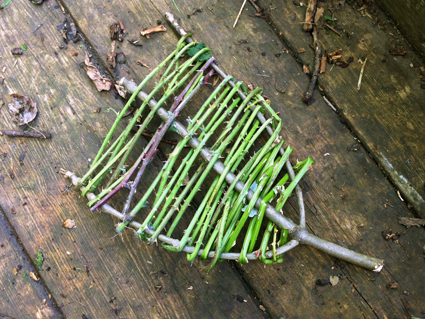
The idea was for the students to make interventions on site.  However, following an active foraging session, a purposefully short introduction to cording and twining and a cup of tea, they all got stuck in and produced the various constructions illustrated here.  We ran out of time to make our interventions. I’ll just have to plan a two day workshop next time so we have time to install things in situ and so  surprise joggers, dogwalkers and nature lovers who frequent the park.


twined hedgerow materials including brambles,
hops, cherry and willow

I deliberately kept the imparting of technical know how down to a minimum, so students had the chance to familiarise themselves with the materials they were using in their own way, and rely on their own specific ways of making and constructing.  Less information often means more in this case, and the feedback overall was very good at the end of the day.  Note to myself, I must do this more often...


plaiting with willow and cording with ash leaves


Sunday, 30 September 2012

Melting Down for Rosemary Lee


This year I'm taking part in Rosemary Lee's Melt Down, included in the Dance Umbrella 2012 programme and which will be performed in Granary Square, Kings Cross, London, on Sun 7, Sat 13 & Sun 14 October.

Originally commissioned for Dance Umbrella 2011, where the piece was performed around a square in Bloomsbury, it has now been reworked suit the busier and more urban location at the back of the station.

Showing you a picture of us rehearsing might be giving too much of the game away, so I've included the image above, where a garment was used as a prop in a warm up exercise lead by our rehearsal master Luke Birch before doing an actual run through of the Melt Down.  To me the image says something fundamental about the piece, and all things for that matter - we are all subject to the one inescapable force, and that is gravity.

background image by John Sturrock, foreground
image by Richard Oliver


Friday, 28 September 2012

vanity weaves


Over a month already since the last weekly post…  Time is a fierce adversary!   Making up for it now with a brand new film of the newly restored weaving time machines. Commissioned privately over a year ago, I teamed up with the genial Marcelo Barbosa to develop these sculptures.

Hacking into old IKEA lampshades, as well as various basketry items originally collected for Hybrid Basketry, the woven capsules rotate inside one another and generate light. They measure time, weaving light and motion in a continuous cycle. Think of them as inverted kaleidoscopes, projecting light patterns onto their surroundings.  This kinetic playfulness is double edged however. The light is trapped in the complex intertwined patterns of the weave and you’ll notice a skull at the centre of one of the capsules. The sculptures are vanitas, reminding us that with each rotation we are irremediably closer to death. All light creates shade.


Only while writing this am I reminded of Come Back, an equally dark and mysterious light installation I created at St Pancras Chambers for the exhibition Shine curated by Up Projects, a London based arts organisation who are soon to celebrate their 10th anniversary. Come Back consisted of a rotating projection in a darkened room spelling the words that make up it’s title and could only be seen from the outside through a half opened door.  It’s strange to realise how creative thoughts, something I've referred to in my previous post on this blog, tend to come round in circles.


Monday, 20 August 2012

same old thing

cotton and wool, 1995/6 (top) and 
dailymade May 2012 (above)

I’ve taken on reorganising the studio and office this summer, at last! This is some undertaking after years spent hoarding and accumulating stuff. As anything is potential material for work, I have the perfect excuse to keep hold of all sorts of stuff, and crisis point was reached during two recent visits at the studio when the work I produced could hardly be viewed amongst stacks of materials, equipment and tools. So, drastic action had to be taken!

pecan nuts, beads and wire, 2006 (top) and 
dailymade July 2012 (above)

Going through old boxes I was struck how some of the work made almost two decades ago echoed some of my recent dailymades. Some of them have actually found their way on recent posts on the blog.  This made my think of the words of the late genial performer and choreographer Nigel Charnock in an interview with Sonia Baraga.  Artists he said always tinker at the same piece in order to get to that ‘thing’, whatever it is, and ultimately fail to do so.  This doesn’t matter in the end, as the process of getting there is what counts and the ultimate goal takes second place.  Wise words, and Nigel, you will be very sadly missed.

the making of Garland #10 (top), 2006 and prop workshop
for One giant Leap (above), 2012

toothpicks and wire, 1996 (top) and 
dailymade August 2012 (above)

dailymade April 2012 (top) and 
dailymade August 2012 (above)


Friday, 3 August 2012

art for health: remembering and forgetting

Teddy Boys, D.A. haircuts and Camberwell Beauties

‘Memory is a perpetually actual phenomenon, a bond tying us to the eternal present; history a representation of the past’ – Pierre Nora

These last few weeks I have been collecting memories from patients suffering from aphasia with three other artists for Little Boxes of Memories, a project run by Entelechy Arts in partnership with the Museum of London and funded by the Heritage Lottery Fund and Lewisham Hospital Arts Committee.  These memories will provide material for the creation of multi sensory boxes to be used as resources in schools, props in a performance as well as potential exhibits in a future exhibition.


My focus throughout the project was to collect these memories through making. Symptoms of aphasia being commonly movement as well as speech impairment, I was prepared for a challenge.  I brought in objects and materials to each of the sessions and used these as introduction, 'meeting points', that prompted engagement and exchange.  Over the course of the few weeks more objects and materials were brought in by the patients and furnish their bedside spaces and were shared amongst themselves.  This gave the patients a sense of agency and choice and created a sense of community much needed at a time of loss, fracture and trauma.

ball inspired by T.'s tales of football and cricket
3-way plait inspired by D's recollections of making 
across three generations in her family
Many rich and evocative stories were communicated to us over the course of the few weeks and we are now working on how to represent these in the boxes. This process had started early for me as I responded to the stories by producing objects with the patients, which in turn prompted more conversations and revelations and created a connection between us. Reading studies on memory, I recognised how the fear of forgetting can trigger memory and how the reverse is also true.  Pierre Nora argues in Les Lieux de Mémoire how memory stands in opposition to history rather than being complimentary to it.  He writes 'memory, insofar as it is affective and magical, only accommodates those facts that suit it; it nourishes recollections that may be out of focus or telescopic, global or detached, particular or symbolic'. How accurate the patients' memories were didn't matter so much in the end because it is in the recounting of these itself that the past was reconciled with the present, and the possibility created for future imaginings.

‘Memory takes root in the concrete, in spaces, gestures, images, objects; history binds itself strictly to temporal continuities, to progressions and to relations between things.  Memory is absolute, while history can only conceive the relative.' – Pierre Nora

tales of London recounted by patients about to be released
(London AZ pages)