Showing posts with label Jess-The-Weaver. Show all posts

Tuesday, 10 March 2015

the fabric of Stave Hill (part 3) - Jess's story


The loom that came to life without its heddle

I have come to eagerly anticipate wintery days spent outside at Stave Hill Ecological Park with Shane, learning how to bundle up freshly harvested willow or using basketry techniques to build a heddle for our loom. All this gleaned while watching Shane’s hands dancing with (sometimes precarious) expertise when pruning or untangling gardening twine between his fingers. I now have the pleasure of sharing my words regarding the day it all came together and we made our first loom at Stave Hill, without the aforementioned heddle!

the discarded heddle

Shane and I started the morning off aiming to launch our Catalan platter inspired heddle but promptly changed our minds thanks to inspiration from Eric Boudry’s Book of Looms. A method I would normally have used simply to walk the warp or measure out the threads became the backbone of our piece, and once it was in place there was no way we could thread the heddle without cutting loose the work we had already done.


All the hard thinking and speculation was worth it when we figured out how to interpret the illustration in the book as reality on site. We then had to fine-tune it with our hands; fingers repeatedly counted and recounted threads, the warp was combed to equalize the tension and willow cross bars were put in place.

A quote from the same book by Dr Junius Bird, curator emeritus of South American archaeology at the American Museum of Natural History (and possible real life inspiration for the fictional movie character Indiana Jones!) came to mind as we were musing on how to proceed with our making. Bird compares the invention of the heddle to the discovery of fire-making methods. Though the latter is much more significantly recognised historically, “both have an antiquity which, though by no means comparable, still remains a mystery”. It was this mystery we had to untangle and it happened where the areas of our expertise overlapped, with only the means we had available to us at Stave Hill.


Making a new heddle involved Shane looping an extra bit of twine around a willow pole and picking up alternate threads from the warp. A shed stick was also required to complete the plain weave structure. There was some arguing over exactly how this was to work but we persisted and suddenly the gap required to insert the water reed as a weft materialized

The whole device needed to be operated by two arms moving laterally in opposing directions; there was no familiar up-down movement of the heddle here. The pair of heddle sticks had to alternately stand at ease and then be anchored in the ground to successfully open the right shed.


We continuously stepped back to gain perspective on the lines we had created and marvelled at these echoing the vertical growth of the trees. Close up the weaving framed undergrowth, the sky and our bodies alike with the horizontal contours we had mapped.

It is truly a unique loom, one so different to any I have worked with or built before, and which requires a pair of hands on either side of the warp. Weaving using this loom becomes a complex dance for two and a reflection of the working relationship that Shane and I have built up through the exchange of ideas and skills shared during our time at Stave Hill.


Looking back, it was great to exchange perspectives both verbally in the moment from our mirrored standpoints, as well as afterwards with the physical exchange of photographs. Repeatedly seeing the animated concentration on my face and in my hands, captured by Shane, brings back the magical wonder at making these two trees into a loom with as little as a few willow sticks and some gardening twine.

I can also now marvel at my serendipitous choice of clothing that day  – I could never have planned to echo both the budding moss and the shade of twine chosen by Shane when I donned my fluorescent cycling jacket and sulphur woollens that morning!


Sunday, 8 March 2015

the fabric of Stave Hill (part 2) - Shane's story


‘Nature is an active component of art, not a setting for it’ – Ben Tufnell

Pictured here are the results my weaving endeavours with Jess last weekend. Both of us scouted around to find a site at Stave Hill for making a loom - see loom weaving and willow heddles post. We decided on the location above as both of us were interested in how the loom would intersect with the existing path and in the time it took to set up the warp and weave the fabric, we trod our own desire line at one end of the loom. 


We took pictures of each other as we weaved and thought it would be a good idea to swap each others  snaps and both write about the process here. This is my version of events, the next post will be Jess’s account, my first guest writer on the blog. 


Having been much inspired by Eric Boudry’s Book of Looms and the description in it of a two-bar loom dating back as early as 6000 B.C., I suggested not using our specially made willow heddle for this job; a ridiculous idea in many ways after all our talk about these handmade heddles - see previous post. We used gardening twine for the warp and reeds for the weft.


This type of loom requires a shed stick and heddle rod placed between a breast and warp beam; in our case two trees. The action of creating shed and counter shed to allow the weaving of the weft is performed by each of us standing on either side of the warp, alternatively pushing and pulling the shed stick and heddle rod. Five hours later, and after much exertion, we produced almost two meters of fabric which we are completely thrilled about. The physicality of the whole process (stretching the warp, repeatedly pushing the reeds through it, manipulating the heddle and shed stick) reminded me of Ron Arad’s following definition of design as ‘an act of one imposing one’s will onto materials to perform a function’. 


I don’t really agree with this however. It seems unfair on the materials, and the whole process was more of a dance than a battle of will. I like to think of art or design as a collaboration between the materials and the maker. Using materials readily available onsite (apart from the gardening twine of course) as well as the setting for the piece, I think we did achieve this.

Over to you Jess…


photos: Jessica Smulders-Cohen

Saturday, 28 February 2015

loom weaving and willow heddles


Jess and I decided a few months ago to build a loom at Stave Hill Ecological Park – see The Fabric of Stave Hill . We’ve now made a couple of rigid heddles (pictured above) which will be used to build a loom and weave fibres and plants harvested in the park.


The round heddle followed a project in Practical Basketry Techniques, inspired by the Catalan platter. The other heddle was made using willow in combination with a couple of bow saw handles. To finish this heddle willow bark and twine will eventually be plaited across both ends of the handles to replace the cable ties now used to fasten these together.


We tried various methods for constructing the heddles and will soon find out how efficient these are when we put them to the test in a couple of days. I'll keep you updated on the outcome of this in my next post.

While making these we couldn’t resist making a few of these plaited cones with the freshly cut willow we were using, inspired by another plaiting project included in Practical Basketry Techniques. While thinking these might be used as bird feeders and hung from trees, Jess clearly had some other ideas, as you can see below! Working with others does wonders for creative inspiration!


Friday, 27 February 2015

willow weave / knot garden

A few weeks ago Rebeka Clark at Stave Hill Ecological Park mentioned that the willow hedge pictured below needed coppicing. The willow stems have put a heavy strain on the metal fence at the base of the pollarded willow after two years of growth that were periodically subjected to high winter winds.


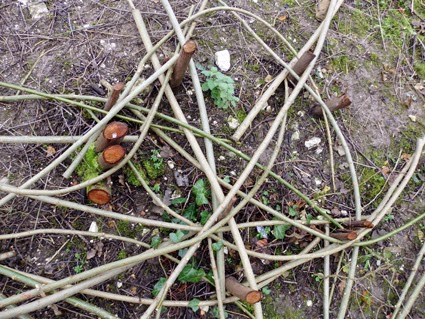
So with the help of Tina Götschi and Jess Smulders-Cohen we started to cut down the hedge. We bundled up the shorter stems and used the longer ones to weave around the recently coppiced  black thorn shrubs at the other end of the park. We did this in several stages, illustrated below.

It’ll be interesting to see what will grow between the bent willow stems as Spring marches on. I suspect the weaving will disappear from sight only to reappear again in the autumn. At that point more willow might be added to elevate the lacy ground willow pattern into low hedges. Plants growing within this network of willow stems and black thorn stumps might give the appearance of a knot garden, albeit a very loosely structured one. We'll just have to wait and see.