Showing posts with label pollarding. Show all posts

Saturday, 1 April 2017

weaving the willow (Knot Garden 2015/2017)


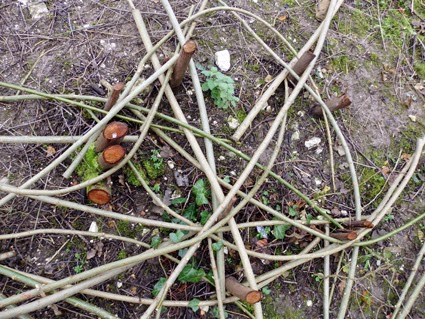
It’s been a couple of years since I wove willow around blackthorn (Prunus spinosa) stumps near the chalk pond at Stave Hill Ecological Park. That summer it looked something like what you see pictured above.

Nettles, garlic mustard and goosegrass were abundant and later on taken by new blackthorn shoots. This year I cut is all these back, ahead of birds nesting in the new thicket, and added freshly cut willow styakes from a pollarded fence nearby to the existing low fedges – see also this post from more info and images.

I might weave a few more stakes before the new spring growth prevents me from doing so and hides the work once again. I’m hoping this time to make a better job of documenting the transformation on the ground in the coming months. Keep you posted… 


Friday, 27 February 2015

willow weave / knot garden

A few weeks ago Rebeka Clark at Stave Hill Ecological Park mentioned that the willow hedge pictured below needed coppicing. The willow stems have put a heavy strain on the metal fence at the base of the pollarded willow after two years of growth that were periodically subjected to high winter winds.


So with the help of Tina Götschi and Jess Smulders-Cohen we started to cut down the hedge. We bundled up the shorter stems and used the longer ones to weave around the recently coppiced  black thorn shrubs at the other end of the park. We did this in several stages, illustrated below.

It’ll be interesting to see what will grow between the bent willow stems as Spring marches on. I suspect the weaving will disappear from sight only to reappear again in the autumn. At that point more willow might be added to elevate the lacy ground willow pattern into low hedges. Plants growing within this network of willow stems and black thorn stumps might give the appearance of a knot garden, albeit a very loosely structured one. We'll just have to wait and see.


Tuesday, 30 October 2012

the secret of youth


Left my foraging ways behind in favour of urban forestry last weekend as I collected lime wood for making what I’m hoping will be a series of kinetic sculptures.  It will involve balancing wooden spirals (larger scale versions of the one pictured below) on an axis and have the wind spin them. More on this on a future post on this blog, meanwhile back to pruning, or rather pollarding…  


My good friend Marcelo, who I’ve worked with on the Weaving Time Machine sculptures helped me collect the wood that Jack (pictured up the tree) felled with his handy chain saw.  It was impressive to see him hoist himself up, make a few expert cuts, and see all these branches fall down all around us before hopping to the next tree.  We were kept really busy at ground level sawing, pruning and stacking the wood to make room for more branches to come down.  So much destruction, such a thrill… Spooky!


Pollarding makes trees live longer apparently and encourages new growth as their tops are not subjected to so much windage and weight.  Trees are effectively kept in a juvenile state. Fabiane, whose garden the limes we were in was complaining about the secretions from the trees spoiling the laundry she leave out to dry.  It sounds like in a couple of years' time the leafy teenagers will be giving her yet more trouble!  Still, on the upside, there will be plenty more lime tree blossoms to collect to make soothing infusions (linden tea), and sipping these rejuvenating brews, the sticky laundry won’t seem such a problem anymore I’m sure.