Showing posts with label dance. Show all posts

Tuesday, 15 November 2016

Score for Sittard / Cultuur maak(t) je


Score for Sittard, a piece commissioned by Joanna van der Zanden and artist Jeanne Van Heeswijk for Cultuur maak(t) je at Sittard’s new museum De Domijnen, in Dutch Limburg.

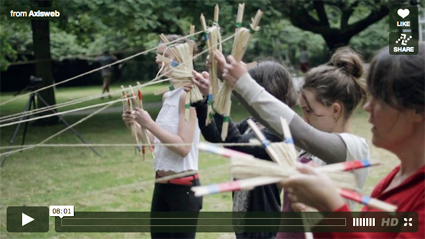
The piece started with a local group of ramblers collecting materials for make cords with which are pictured here installed in the museum. The making of these was done in formation leading to the cords being used as props to dance with and being tied into knots and plaited braids (the dance scores), before being untied again.

More info on the project is included in the following link.  


Thursday, 22 September 2016

strung


strung - A collaborative film and performanc by Jane Fradgley & Shane Waltener for 
Reclaiming Asylum, an exhibition at the Bethlem Gallery

Below are extracts from the exhibition catalogue. All images are film still shot by Antonia Attwood
  

Whilst exploring ideas of being grounded (or not), facing anxiety, risk taking, embracing the unknown and the journeys taken as a consequence of all of this. A young woman weaves and moves through an insecure structure, feet off the ground, attached to the tree itself, which while defying gravity gives her support, safety and freedom to climb.


Based around a majestic Lebanese cedar tree next to the Bethlem Gallery, Fradgley and Waltener have come together employing stitch, movement, sound and visuals to create new performance and moving-image based work with Laura Glaser (dance artist), Zoë Gilmour (sound artist) and Antonia Attwood (videographer). Inspired by Fradgley’s project held and Waltener’s woven installation and performance work, strung, is an enquiry into notions of personal boundaries, freedom and restraint.


seeking movement for blessing

barefoot dancing

cutting shapes

shifting


yearning and stitching

blissfully climbing

breathlessly

falling


darkness looming

unnatural holding

strung out

pausing


melting gently cleaving

soul transcending

end of the

weaving


A poem by Jane Fradgley


Note to myself: Find out what a work might be about. Let everyone get on with what they do best. As soon as we all know, the work will be done.- Shane Waltener

Tuesday, 10 March 2015

the fabric of Stave Hill (part 3) - Jess's story


The loom that came to life without its heddle

I have come to eagerly anticipate wintery days spent outside at Stave Hill Ecological Park with Shane, learning how to bundle up freshly harvested willow or using basketry techniques to build a heddle for our loom. All this gleaned while watching Shane’s hands dancing with (sometimes precarious) expertise when pruning or untangling gardening twine between his fingers. I now have the pleasure of sharing my words regarding the day it all came together and we made our first loom at Stave Hill, without the aforementioned heddle!

the discarded heddle

Shane and I started the morning off aiming to launch our Catalan platter inspired heddle but promptly changed our minds thanks to inspiration from Eric Boudry’s Book of Looms. A method I would normally have used simply to walk the warp or measure out the threads became the backbone of our piece, and once it was in place there was no way we could thread the heddle without cutting loose the work we had already done.


All the hard thinking and speculation was worth it when we figured out how to interpret the illustration in the book as reality on site. We then had to fine-tune it with our hands; fingers repeatedly counted and recounted threads, the warp was combed to equalize the tension and willow cross bars were put in place.

A quote from the same book by Dr Junius Bird, curator emeritus of South American archaeology at the American Museum of Natural History (and possible real life inspiration for the fictional movie character Indiana Jones!) came to mind as we were musing on how to proceed with our making. Bird compares the invention of the heddle to the discovery of fire-making methods. Though the latter is much more significantly recognised historically, “both have an antiquity which, though by no means comparable, still remains a mystery”. It was this mystery we had to untangle and it happened where the areas of our expertise overlapped, with only the means we had available to us at Stave Hill.


Making a new heddle involved Shane looping an extra bit of twine around a willow pole and picking up alternate threads from the warp. A shed stick was also required to complete the plain weave structure. There was some arguing over exactly how this was to work but we persisted and suddenly the gap required to insert the water reed as a weft materialized

The whole device needed to be operated by two arms moving laterally in opposing directions; there was no familiar up-down movement of the heddle here. The pair of heddle sticks had to alternately stand at ease and then be anchored in the ground to successfully open the right shed.


We continuously stepped back to gain perspective on the lines we had created and marvelled at these echoing the vertical growth of the trees. Close up the weaving framed undergrowth, the sky and our bodies alike with the horizontal contours we had mapped.

It is truly a unique loom, one so different to any I have worked with or built before, and which requires a pair of hands on either side of the warp. Weaving using this loom becomes a complex dance for two and a reflection of the working relationship that Shane and I have built up through the exchange of ideas and skills shared during our time at Stave Hill.


Looking back, it was great to exchange perspectives both verbally in the moment from our mirrored standpoints, as well as afterwards with the physical exchange of photographs. Repeatedly seeing the animated concentration on my face and in my hands, captured by Shane, brings back the magical wonder at making these two trees into a loom with as little as a few willow sticks and some gardening twine.

I can also now marvel at my serendipitous choice of clothing that day  – I could never have planned to echo both the budding moss and the shade of twine chosen by Shane when I donned my fluorescent cycling jacket and sulphur woollens that morning!


Thursday, 20 November 2014

Score for Fermynwoods


The image above is a pictorial score included in Open Online Five – Just like This, an online exhibition curated by Fermynwoods Contemporary Art. The image below is graphic score, the third and final iteration of this instruction.

'In weaving, regularity of form and rhythm repetition of the same
movement are necessarily connected' - Franz Boas

Sunday, 16 November 2014

The Whitechapel Gallery talk (added value re-write)

Stairwell Weave-In, Dovecot Studios, Edinburgh

Remaking means added value. It's something I addressed at the talk I delivered last Thursday at the Whitechapel Gallery, part of the Real World series of talks curated by Orlagh Woods for Artquest. In the light of this I’ve decided to re-write my notes and publish them here. This partly for myself, but also for those who couldn’t attend the event which did sell out. I’m doing this in the form on a Q+A, asking myself questions and answering them. The topic of the talk was how do artist manage the boundaries of art and craft and how are these practices shifting and evolving.
Shane, how do you negotiate the boundaries between art and craft?
Badly. My work is often perceived in a fine art context as being too crafty and in a craft context as being too messy. Meanwhile Crafts magazine in a recent review referred to me as a performance artist. So, I’m either terrible at negotiating these boundaries or an expert at it. You can be the arbiters of this.


Are these boundaries useful anyway?
Yes, at least to know when and where to step over them. Glenn Adamson in his book Thinking Through Craft puts a solid argument for these to be clearly defined so we're able to use them as a filter to understand what we are looking at. 
How do you define these then?
How much time do we have? An answer to this can only lead to endless debating, but here goes… My feeling is that craft objects have to refer in some way to the process of their own making, while art objects don’t. Art prompts you to look at it from another point of view than how the object is made. My interest in process over product is probably why my work is perceived as craft. The boundaries are porous of course, and it is always worthwhile looking outside your own practice to reinvent it and push your work forward. Someone told me recently that this question of boundaries will only be of real concern to crafts people and not fine artists. A perceptive comment I think. Rather than think about how to define art vs. craft, better to think of how to identify with either. Key to this is context and presentation, which qualifies what we are looking at and how we experience it.


Tell us more?
Objects are not revealed to us by looking only but through interaction. The value of objects all too often gets in the way of this interaction. What do you know of a pot unless you hold it in your hands after all? Art ought not simply to be about communicating ideas but also to convey experiences. We’re not just brains on sticks; we need to relate bodily to objects. The preciousness of objects starts working against them, requiring them to be displayed on plinths, vitrines, cords to separate them from their audience. One of Richard Tuttle's pieces in the current exhibition apparently required two first class seats (one for the artwork, one for the courier) to be shipped from the States to London. Getting up close and interacting with this object in this case is of course impossible and probably why the artist himself prefers his work to be shown in a domestic rather than a gallery or museum context.

Making by Instruction workshop at The Poly, Falmouth

What are the answers then?
Adopting participatory approaches when making and showing work, engaging audiences with processes and materials of making rather than presenting them for the sole purpose of being looked at. Daniel Miller writes ‘objects don’t matter, it’s what you do with them that matters’. Pioneers of participatory work talk about how ‘the object has lost it’s significance unless it is a mediator for participation’ (Lygia Clark). Helio Oiticica states ‘a work should range from the givens (things already produced), to the livings (the route to be traced by audience) and the transformable givens (the objects that demands inventive participation from the creator)'. There are many reasons why I have chosen to do participatory works over the past 10 years and one of them is to enrich the connection between object and audience. 
Another strategy might be to do away with objects altogether. Objects don’t last forever (taking a larger historical perspective on this) and can always be remade. I’m very interested in the process of making by instruction and the process of interpretation that goes on as work is reproduced. Value can be added to an original work as it is remade and therefore reinterpreted. So why not keep instructions and scores rather than the objects themselves and involve artists and audiences in the remaking of these? This is after all is common practice in dance, theatre, music. Why not art?


Knitting Piece #11, Prague Biennial

Isn’t the answer obvious? Not everyone can paint Monet’s Waterlilies.
True. There is of course a case for safeguarding artworks, but the use of plinths and vitrines, despite being an issue for half a century or more, still needs addressing I think. Thinking about this I’ve been looking again at the work of Phyllida Barlow, and reading her ‘Hatred of the Object’ essay, where she denounces the use of vitrines – they deaden work, make it safe, clean, polite. Her work embraces fully the sculptural over the pictorial. It celebrates making and materials in all its mess, awkwardness but also subtleties. Barlow never looses sight of the temporality of sculpture, celebrating how things fall apart, rot, melt and disintegrate. The making of her sculptures and installations, or elements of these, are often rehearsed and then performed in situ to create the work. After being displayed they are dismantled and parts reused for making other work. I love the ecology of this. I also love how these monumental works carefully calibrate the relationship between space, body and object, carefully considering what materials can do for a space as well as the people in it.

rehearsing Garland #21 with
Cheryl McChesney Jones at Siobhan Davies Dance Studios

Is there then an ideal model for displaying craft?
I’m not sure about a model but a guideline could be to think about what André Lepecki describes as the constitutive qualities of dance: ephemerality, precariousness, corporeality and scoring.
Thank you very much Shane. Let’s hand it over now to the audience now. Are there any questions?

Lacetell performance at Yan Tan Tethera, Cecil Sharp House

Wednesday, 30 October 2013

collaborating with myself


‘The real issue is not how do you find your voice, but how to get rid of it’ – Phillip Glass

Can this be the benefit of creative collaboration?  Not according to Sally Potter. It’s ok to relinquish your voice if you have one, but some of us don’t have had that privilege. If you’re lucky enough to have a voice, own it and celebrate it! Collaboration is all too often an excuse to mask the embarrassment of claiming authorship for something she argues.  Mmm, now there's something to argue about…


This and other ideas on creative collaboration were shared in a panel discussion at Central St Martins, an event part of Dance Umbrella 2013 held earlier this month, where a number of speakers working across film, theatre and dance talked about the subject from directed collaboration to shared authorship. Working as I do in participatory settings, this was of interest to me and not least because of my recent involvement in a couple of projects with Entelechy Arts.

One of these is Ambient Jam, a unique programme of movement and sensory-based work with adults and young people who have profound and multiple disabilities. Many company members have physical disabilities combined with learning disabilities preventing them from expressing in words their experiences, interests and needs. In these sessions, the body and its senses provide the ways and means for expression and communication through improvisation, social dance and live movement. The multi-sensory workshops and short term projects that arise from them lead to a creative dialogue between all involved.


Contributing to these workshops, primarily as a visual artist, has challenged my understanding of what participation and creative collaboration is.  In a situation where verbal communication cannot be relied on, who facilitates what, who leads who, and whose creativity is explored isn’t so clear anymore. You have to forget what you know, loose your ‘voice’ as it were, and be completely in the ‘moment’ for the creative exchange to be meaningful. The outcome is you do find your voice in unexpected places. As the dancer and choreographer Akram Khan put it in the talk referred to above, to hear music we sometime need to stop playing and simply hold the flute to the wind.


What have these pictures got to do with any of the above you may ask? Well, images of Ambient Jam can be seen on this link, meanwhile I've illustrated here images taken while dismantling my installation at Nottingham Castle. Even when working alone, we are collaborating with our memory and our acquired knowledge. The dismantling of the work led to the production of objects that were the result not only of a collaboration between myself, but also the material I worked with, the site and the weather.  The process was planned and methodical, but they were also happy accidents that were embraced and lead to what you see pictured here.


Thursday, 29 August 2013

it ain't nothing without you...

'Art isn't what you make, but what you make happen'
- Jeremy Deller

When working on participatory projects, the challenge always is to know how much information to impart to the participants. Saying too much can result in diminished creative input from the group. So how do you get the most from the participants? How do you best capitalise on their creative ambitions while also managing artistic control over the piece? How do you make on the spot decisions when exploring new creative ideas? These are some of the questions I asked myself during the Delve Deeper Intensive with Helen Carnac and Laïla Diallo last month at Siobhan Davies.

Choreographers by nature of their work are likely to be more familiar with this than other artists. I was most impressed with Laïla’s delivery of various tasks she set to the group: economical, measured, open ended.  It prevented us from ‘end-gaming’ what the outcome would be and helped us embrace the unexpected while also valuing the minutiae of whatever we were doing.


A large part of my installation in the Make Believe exhibition at Nottingham Castle, separate from the weaving between trees (see previous post), involved using fencing pins in the lawn, as you would pins in a lace pillow, to produce ‘lace’ around the grounds of the castle.


To prepare for this I practiced various stitches in the studio on an actual lace pillow and drew up a pattern to follow when making the work on site.  However as soon as we started, the pattern had to be scrapped. The action of working the sisal twine using custom made bobbins to cover the grounds lead me to rework the pattern I had and make up new stitches as we worked our way across the lawn.  What guided me through this was allowing the participants to find their own way of working with the materials and each other. This improvised method, based on set manoeuvres, proved the best way of making the ‘lace’ in the end.


It’s nice to think that with a different group, the outcome would have been very different, and without anyone, the piece could not have been realized at all.


Wednesday, 31 July 2013

nothing can ever be the same again...

repetition is transformative

More thoughts on Sharing Making Moving, Independent Dance’s summer intensive at Siobhan Davies Studios – see also previous post.

actions can remain the same
but intention changes everything
undoing is one way of making
making is moving
movement is change
all making is improvised
through movement we are in touch with the absolute
- Colin McLean (on Buddhist prayer wheels)