Showing posts with label willow. Show all posts

Saturday, 1 April 2017

weaving the willow (Knot Garden 2015/2017)


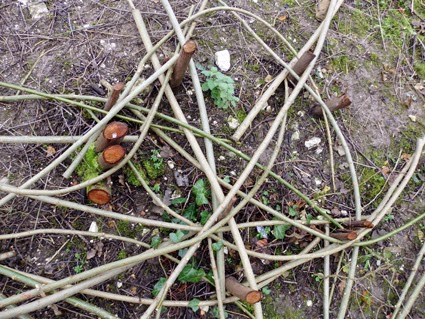
It’s been a couple of years since I wove willow around blackthorn (Prunus spinosa) stumps near the chalk pond at Stave Hill Ecological Park. That summer it looked something like what you see pictured above.

Nettles, garlic mustard and goosegrass were abundant and later on taken by new blackthorn shoots. This year I cut is all these back, ahead of birds nesting in the new thicket, and added freshly cut willow styakes from a pollarded fence nearby to the existing low fedges – see also this post from more info and images.

I might weave a few more stakes before the new spring growth prevents me from doing so and hides the work once again. I’m hoping this time to make a better job of documenting the transformation on the ground in the coming months. Keep you posted… 


Tuesday, 9 June 2015

Something old, something new, something borrowed, something blue...


Given the bindweed at Stave Hill is growing so fast on the willow wigwams I installed there a couple of weeks ago, I’ve added more height by adding toppers onto them. This is something I planned and talked about in a previous post on farming bindweed.


In contrast to other works in the park made using only material growing onsite, I've incorporated readymade objects in the making of these toppersI now have to wait for the bindweed to wrap itself around them, marrying the industrially made elements with the willow whips and cedar suckers.


The thought of these different elements being married made me think of the following good luck  wedding rhyme: something old (the willow whips), something new (the growing bindweed), something borrowed (the found objects) and something blue (the sky above making all this possible). Now doesn't working outdoors in June bring out the romantic in me?


Friday, 24 April 2015

time to sit back and do nothing


Spring time gardening seems to be all about taking it easy. I’m spending more and more time as a resident artist at Stave Hill Ecological Park not doing anything else than observing the amazing transformation that is taking place there.

Remember the piece woven with willow rods from a pollarded hedge to create something of a knot garden? If not take a look at this previous post and compare photos taken then with those illustrated here. My thoughts at the time were to grow different herbs in the various sections created by the network of willow rods. Since then so many plants have come out of the ground there is no need for this - garlic mustard, purple nettles, goose grass, wild strawberry and dandelion to name but a few have colonised the place. I’ll ask Rebecca Clark when I next visit to help me identify more of these. With twenty six years experience working in the park there are very few I know she won’t be able to identify!

garlic mustard
more garlic mustard
purple nettles and dandelion
grass, an unwanted weed


All I’ve got to do now is enjoy the verdoyant sights and to do nothing, except maybe a little weeding to uproot the invasive grass. In a few weeks time I’ll be able to  harvest the edible plants and reap the rewards of my inactivity. Could life be any sweeter?

goose grass and wild strawberry
a mix of all above and tree saplings

Tuesday, 3 March 2015

caring at the YMCA


Jess’s passion for plaiting willow and corn doilies (see loom weaving and willow heddles) inspired me on a project with young carers at the YMCA in Darlington, the week before last.


The session started with a tour of the garden (see flying fedges). The children chose their favourite spot and collected various objects found on the former industrial site. We then plaited willow to make containers to put these in and displayed them in their favourite spot in the garden. They took some of these home with them and what is illustrated here is what was was left behind.


After the session I used more of the willow to weave what would be the back of a chair using an old wooden palette as a seat. The aim was to use the seating platform to level off the slopey ground in the semi sheltered areas created by the fedges, and provide a space for residents and visitors to sit and relax.


Unfortunately time ran out to finish this but hopefully Sally, Dave and the volunteers might be able to work on this in the next few weeks, so weary bones can be rested there for comfort and contemplation very soon.


Saturday, 28 February 2015

loom weaving and willow heddles


Jess and I decided a few months ago to build a loom at Stave Hill Ecological Park – see The Fabric of Stave Hill . We’ve now made a couple of rigid heddles (pictured above) which will be used to build a loom and weave fibres and plants harvested in the park.


The round heddle followed a project in Practical Basketry Techniques, inspired by the Catalan platter. The other heddle was made using willow in combination with a couple of bow saw handles. To finish this heddle willow bark and twine will eventually be plaited across both ends of the handles to replace the cable ties now used to fasten these together.


We tried various methods for constructing the heddles and will soon find out how efficient these are when we put them to the test in a couple of days. I'll keep you updated on the outcome of this in my next post.

While making these we couldn’t resist making a few of these plaited cones with the freshly cut willow we were using, inspired by another plaiting project included in Practical Basketry Techniques. While thinking these might be used as bird feeders and hung from trees, Jess clearly had some other ideas, as you can see below! Working with others does wonders for creative inspiration!


Friday, 27 February 2015

willow weave / knot garden

A few weeks ago Rebeka Clark at Stave Hill Ecological Park mentioned that the willow hedge pictured below needed coppicing. The willow stems have put a heavy strain on the metal fence at the base of the pollarded willow after two years of growth that were periodically subjected to high winter winds.


So with the help of Tina Götschi and Jess Smulders-Cohen we started to cut down the hedge. We bundled up the shorter stems and used the longer ones to weave around the recently coppiced  black thorn shrubs at the other end of the park. We did this in several stages, illustrated below.

It’ll be interesting to see what will grow between the bent willow stems as Spring marches on. I suspect the weaving will disappear from sight only to reappear again in the autumn. At that point more willow might be added to elevate the lacy ground willow pattern into low hedges. Plants growing within this network of willow stems and black thorn stumps might give the appearance of a knot garden, albeit a very loosely structured one. We'll just have to wait and see.