Friday, 25 July 2014

ready steady weave (Festival of Thrift instructible)


Writing... at last!  It has been over three months since the last post on this blog, and weekly weaves has almost become quarterly weaves. That will no longer be however, though I have enjoyed the break. I will report on my recent creative endeavours in the next few weeks, of which there are many.  Meanwhile, here is an ‘instructible’ for a forthcoming project at the Festival of Thrift taking place this September in Darlington.


Commissioned through Home Live Art, the project involves creating an architecturally sized sculptural installation, stitched between trees and buildings at Lingfield Point.  The stitching will provide a framework for hanging woven objects made by visitors at the festival, using locally sourced natural materials and green waste combined with yarn.

The instructible below which should take about 5 to 10 minutes to make is one idea of several in development, for objects that could be produced by visitors to furnish the installation. The technique introduced here is twining, probably the oldest form of basketry and a skill related to what lead to the advent of the first baskets and buildings made by man. For more info see this previous post as well as others on this blog inspired by hedgerow basketry.

Whether the objects to be produced end up being templates for hanging baskets, bird feeders or  simply  decorations, the making of these by some of the 27,000 visitors expected at the festival (!) should be fun, entertaining, inspiring and bring home the fact that most of the stuff that surrounds you, including the growing varieties, can be used creatively. 

So, why not give it a go and come prepared to the festival by making one or several of these to add to the display.  There will be more instructibles posted here very soon. Keep your eyes peeled!


Recipe

To make a twined construction as those illustrated above, you’ll need 10/12 sticks, secateurs (optional), multi coloured string or yarn, an elastic band, a crochet hook (optional) and a pair of scissors.


Cut all the sticks to an equal length, approximately 12 inches / 30cm. Bundle them up using the elastic band making sure to arrange tips (thin ends) on one side and butts (fat ends) on the other. Try use sticks of similar thickness if you can.


Cut a 1/1.5m length of string/yarn. With the tips at the bottom, fold the length in half and loop over one stick as illustrated above. 


Bring the length of string on the right hand side of the stick over the front and loop over the back of the next one on its left. You are now twining!


Twine around all the sticks repeating this process.  These instructions by the way will mostly suit  left-handed people like me, that is twining round the bundle in a clockwise direction. If you are right handed, try reverse the direction you are working in, i.e. twining anti-clockwise.


Notice that as you twine the sticks will want to twist in one direction with the sticks coming apart.  Allow this to happen freely. The wider the gaps, the wider the opening of the 'basket' you are making will be. 


Notice also that one or several sticks will naturally find themselves in the middle as you have twined a full circle round the bundle. It’s up to you whether you want to weave these in by twining around them in between other sticks or remove them.


As the gaps get bigger, add more yarn as illustrated above to fill these in.


To finish, trim the yarn on the right hand side of the last stick have worked one inch from the weave.


Thread the remaining bunch underneath the last round of twining using a crochet hook if you have one. If not, prise the weave apart using fingers to hook the yarn through and trim 1 inch from the weave.


Last, cut the sticks at the top and bottom.
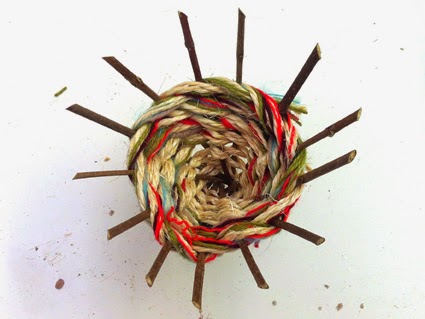

Et voila! Job done!

Sunday, 6 April 2014

bobbin lace or Circular Hey?


Can dance translate into weave? Can stitch become step? Some questions I’ve been pondering about while researching a current project I'm working on for the launch event of Yan Tan Tethera, on May 15th at Cecil Sharp House on the evening of May 15th. It's a project and exhibition curated by David Littler, in partnership with the English Folk Dance and Song Society (EFDSS), celebrating and exploring the connections between the making of textiles and song.

For my part, I’m aiming to create a number of dances based on folk songs and think of these as a making process with the outcome being a piece of fabric. My thinking is as much inspired by maypole as rapper sword dancing, where a resulting knot (or rose) is created by the interlacing of swords. The project will kick off with two exploratory workshops where a number of participants including myself will attempt to combine dance steps with stitch, knot and weave techniques. That is the plan so far and I can’t wait to kick up my heels with yarn and ribbons in my hands.

I’m still looking for participants by the way. The exploratory workshops will be on Thursday 10 April, 7-9pm and Sunday 13 April, 1.30-3.30pm at Cecil Sharp House in Camden. Please email me at mail@shanewaltener.com if you are interested.

Chiffon stitch of Straight Hey?

Wednesday, 26 March 2014

all of this has changed!


I missed one trick with the last post on Ambient Jam - all pictures of materials but no action shots! So here are some more to fill in the gap, this time with people in them.


Facilitators pictured above include Barbara Kane, Gill Moore, Hannah James, Lee Phillips, Mickel Smithen, Peri Mackintosh, Rainer Knupp and myself.

Top photo is by Barbara Kane, others by Rebecca Swift.

Friday, 21 March 2014

all of this can change...

Ambient Jam at West Greenwich House
London Bridge

Sometimes a plan goes completely out the window, and there’s no avoiding it. No matter how prepared you are, things crop up and all you can do is let go and do your best to steer the change of course. Take weeklyweaves for instance, it’s hardly a weekly post is it? And it is not for lack of work being produced... Ideas for posts come and go and might be revisited at some point, meanwhile the production of dailymades, always a priority, has merged with current projects and proposals. One of these is a series of objects created for Entelechy ArtsAmbient Jam sessions and well as a project at Oakleigh School in North London, part of the Little Boxes of Memories touring programme.


Ambient Jam at The Albany
String, tape, plastic and paper

I’m writing this fresh out of an Ambient Jam session, more of a training session on this occasion,  designed for all of us facilitators to try out new things, push ideas forward and feed back to each other.  The latter is always a challenge; the sessions are profound experiences with all communication and activity relying on touch, movement and sound. Words always fail me afterwards... 

Ambient Jam at The Albany
Between Worlds at The Barbican


As briefed, I planned to present something to the group. This would take the form of a question about the use of specific materials and props during sessions. I filled my bag with a few essentials: cellotape, string, fabric, balloons, paper roll, elastic rope and plastic bags. This is my Ambient Jam toolkit, though a reduced version of it on this occasion. I aimed for less be more and not a bore. To answer my question I’d set a simple task: pick a material, play with it, pass it on. Charles would stop playing his instruments for 5 minutes also so we could hear sounds generated by the materials. For once I’d take the opportunity to sit out I’d sit out and observe and reflect.


Fashion project at Camberwell college of Arts
Sock rope

Did this happen? No! We all got stuck in straight away… The elastic came out, we wrapped ourselves in it, balloons were blown, yoga mats were used as blankets and thrown around, bodies moved in all directions in and around the space in different groupings, and parts of the moveable stage were stacked up together in seemingly precarious ways to create slides and a high plinth (and there I am worrying about the health and safety impact of using elastic!). 

plastic bags
Plastic bags and balloon

Though my question was never stated as such, it was answered – I tried new ways of working with materials and saw others do the same.  As with any research, one question leads to many others… A whole set was created by the end of the session, and though the memory of this will stay with us, objects won’t, in this configuration at least. The next Ambient Jam session will start again with a clear space. Might there an alternative to this? Can an end not be our next beginning? Can the transformation and change of all these physical elements in space not be about building down as much as building up, and thinking creatively about undoing as well as doing? What about the ecology of all this: can the salvaged materials left behind from one session not be transformed into a new set of objects used in the next? Or has this happened already? Over to you Ambient Jammers…

Ambient Jam at The Albany
Rehearsal space and prop at Cecil Sharp House
Rubbish in my studio

Wednesday, 5 February 2014

to make or not to make...


Paraphrasing Christian Boltanksi, there is one thing better than making work and that is not to make it. Taking a leaf out of his book, I’ve recently started writing instructions as an alternative to making sculptures.

dailymade #131125

This is something I’ve been thinking about for some time. I've written about 'task driven' work and making by instructions in previous posts, tried this strategy on students and participants in recent projects, and it's become more topical now than ever as I'm writing a new project book on sculpture. It is a device familiar with artists who work in dance, theatre or film, so why not visual artists?  

dailymade #131112

Writing instructions and passing these on seems an efficient and open ended way of communicating ideas and allowing for these to reinterpreted and explored with each iteration of the work; an instruction as opposed to an object remains full of promise and full of potential. My love of making and tinkering with stuff however will get in the way of me being a purist about working in this way, and I'm certainly no Lawrence Weiner, but watch this space for further instructions...


Monday, 13 January 2014

Venice: an abridged encyclopedia


I’m looking through the catalogue of the last Venice Biennial, The Encyclopedic Palace, which I picked up during my visit there last year. Reading it I’m reminded of the thrill it was to see Sarah Sze's Triple Point installation at the American Pavilion; I’d have been satisfied had I seen only that exhibition.

Having been to the biennial on a number of occasions during the mad rush that is the opening week, I was privileged this time to visit the Biennale near to closing week and had more time (and space!) to see most of what was on show, or so I thought. Looking through the catalogue entries for artists showing at both the Central Pavilion and Arsenale however, I’m not sure I did!

To prompt my memory, I’m making highlights in the catalogue. My art hit list will serve me as a kind of manifesto, a set of reminders, guidelines, at a time of year that calls for a new focus and fresh thinking.

The extracts below are all taken from the official short guide. The images are of Sarah Sze’s exhibits, featured at the American Pavilion, a show that was in itself an ‘Encyclopedic Palace’.


‘getting to know the world from scratch, object by object, and body by body’ - Chris Wiley (CW) on Ellen Altfest

‘sculptures act(ing) as ‘places’ rather than objects’ - CW on Carl Andre 

‘insistent monumentalizing of the detritus of modern life, of which (the artist) is a gleaner, a cataloguer, and an alchemist’ - CW on Phyllida Barlow

‘delicate but inexplicable objects (…) appear as elements of a secret language (…) furtive caricatures of secrets, which, however classified or consecrated often serve to instigate and simulate knowledge’ - CW on John Bock


‘Positioned at the intersection of the physical and the imaginative, (the artist’s) paintings seem to affirm that vision itself is a form of interrogation’ - Sam Korman (SK) on Varda Caivano

‘recursive relationship between (the artist’s) real and imaginary worlds’ - Shira Backer (SB) on James Castle

‘The strange sonic forms also inspire a primeval atmosphere (…) the entire environment becomes a mystically charged tableau, as (the artist) modifies the scope of perception to include our sense of what is immaterial’ – SK on Thrisha Donelly

‘represent(ing) the world through a seemingly arbitrary selection of events, objects, phrases, and concepts both historical and imaginary’ – CW on Peter Fischli and David Weiss

‘Buildings provide more than physical shelter and protection: they also frame our perceptions and house our memories (…) offer a blank screen onto which the viewer can project her own ghostly memories – SB on Robert Gober

“limiting your choices (…) gives you power” – Channa Horwitz


‘kaleidoscopic patterning with rigorous symmetry in configurations that call to mind fantastical architectures, or stratified cross sections of earth’ – CW on Augustin Lesage

‘through meditative repetition, tradition remains in motion, guided equally by the history of a craft and the hands through which it passes’ – SK on Prabhavathi Meppayil

‘prob(ing) the relationship between art and artifact (…) the allusion to the monumental, both industrial and antique, belies the work’s apparent fragility’ - Rachel Wetzler (RW) on Matthew Monahan


‘pair(ing) serious content with apparently haphazard execution (…) pizza box design aesthetic (…) awkward layouts and anarchic juxtapositions (…) a panoply of contemporary and outmoded image worlds, as if trying to grasp every fleeting aspect of our culture at once’ – CW on Albert Oehlen

 ‘the eroticism in everyday life’ – SB on Carol Rama

‘the work denies both narrative and the intimacy of a self-portrait: (the artist) shows us instead how one can wrest some sense of self from the stuff of one’s daily life’ – SK on Dieter Roth

‘half-remembered vignettes of dreams or memories’ – CW on Viviane Sassen


‘a principled refusal to add objects or images to a world already supersaturated with both’ – CW on Tino Sehgal

‘god’s ‘spiritual gifts’ – visions, glossolalia, and riotous trancelike dances’ – CW on Shaker Gift Drawings

‘abjur(ing) metaphor, focusing on the relationship between the active participant and sculpture as what generates meaning’ – John Arthur Peetz on Richard Serra


‘offering the possibility to recreating the scenes depicted and making viewers complicit in the act’ – RW on Kohei Yoshiyuki

‘In the end, what is made visible is not artistic genius, but the beauty in the externalisation of inner worlds’ – CW on Artur Zmijewski


Monday, 2 December 2013

repetition is the mother of invention

Dailymade #131120

Over two years into posting one dailymade a day and with nearly 800 of these under my belt, the thought that I am starting to repeat myself has crossed my mind a few times.  Recent work however has put this worry to rest.

Dailymade #131119

A couple of weeks ago I started reusing sisal twine which I have an abundance of in the studio. The plan was to make doilies with the coarse twine, but what happened between start of the process (always the same sequence of 6 stitches looped into a circle) and the finish (when my 10m bundle was used up) resulted in a different outcome every time. The instruction I set for myself inevitably seem to lead to freeform making and the range of objects you see illustrated above and below. 

Dailymade #131122

Sure, I could have been stricter with myself and stuck to an exact pattern, but I decided instead to a keep soft focus on what I intended to make and 'riff' with the material. As a result repeating the same simple tying and knotting manoeuvres lead to much innovation and discovery. So, worrying about posting the same old dailymades, I don’t see it happening any time soon...

Dailymade #131121