Showing posts with label Venice Biennial. Show all posts

Thursday, 29 June 2017

Shopping for an Imaginarium


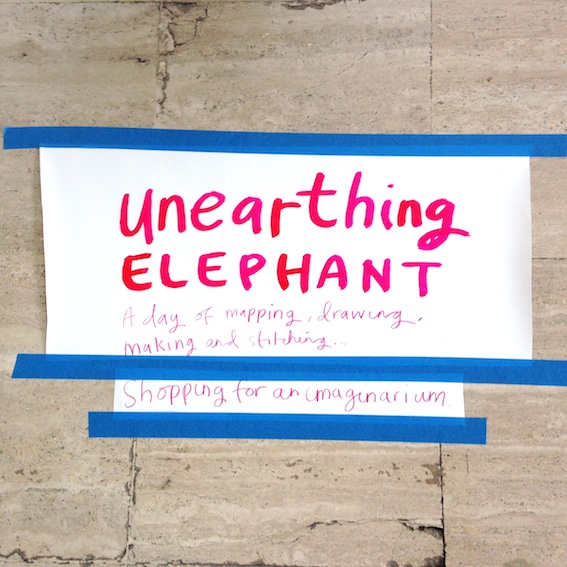
People’s Bureau were invited to contribute to Milton Keynes of the Mind: What does it mean to have a whole new town in mind? For the festival, we planned a screening of Unearthing Elephant, following a recent showing at the Elephant and Castle shopping centre and Tate Exchange. We also planned to lead an activity throughout the day; ‘Shopping for an Imaginarium’ involved mapping out new spaces through stitch, drawing and conversations. Images illustrated here are of the work produced on the day.


Programme information for Milton Keynes of the Mind included the following:

This event explores what goes into making a city that doesn’t exist. Plans for new towns like Milton Keynes were closely tied to economic and demographic predictions of who its population would be and what kind of lives they would lead. How will future folk earn, travel, spend, play and recover from all their labours?  The Milton Keynes Development Corporation responded with an imaginarium designed with our future selves in mind. The result is a paradoxical mix of grand designs, practical compromises and significant follies. Drawing on nearly 50 years of Open University teaching and research, participants will explain what it takes to imagine, orchestrate, govern and make a life in a place like Milton Keynes.

Meanwhile, talking with Rebecca Davies about how we might plan the activity brought to mind A Clockwork Jerusalem, a show at British Pavilion we both saw in Venice, part of the Architectural Biennial in 2014. The copy below are extracts from the catalogue entry for the exhibition, which focused our thinking and directed some of the conversations we had with audiences on the day:
  
…the industrial city combining traditions of the romantic, sublime, and pastoral, to create new visions of British society… looking backward and forwards, combining science fiction and historicism to form ideological and aesthetic approaches to the contemporary city… a product of the picturesque, of landscape, of narrative and of pastoralism (ref. Capability Brown, Ruskin, Turner, Soane)... a product of the industrial and the technological (ref. Brunel, Paxton, Spitfires)… showing British Modernism as a unique and sometime surreal phenomenon… an obsession with these interests written into the visions of this techno pastoralism that span such diverse examples as the Garden Cities, 'non plan' and Milton Keynes... exploring the late and last flowering or British radicalism, the moment it was at its most socially, politically, and architecturally ambitious… a moment (the 50s,60s & 70s) that also witnessed its collapse… a period that sees both epic ambition and complete loss of nerve… grand utopian projects (of that period) were a high point for a vision of society remade through modern architecture… how these modern vision were absorbed into the popular imagination, become sites of new imaginative speculation in the form of novels, film and music (ref. Stone Henge, council estates, Ebenezer Howard, Cliff Richard (!))… ruins and destructions, back-to-the-land rural fantasies…


Saturday, 10 June 2017

Venice Pavilions, an alternative tour... (pt.1)

Pavilion of Artists and Books

Pavilion of  Joys and Fears

Pavilion of the Common

Pavilion of the Earth


Pavilion of Traditions
 
Pavilion of Shamans 
 
Dionysian Pavilion

Pavilion of Colours

Pavilion of Time and Infinity


Monday, 13 January 2014

Venice: an abridged encyclopedia


I’m looking through the catalogue of the last Venice Biennial, The Encyclopedic Palace, which I picked up during my visit there last year. Reading it I’m reminded of the thrill it was to see Sarah Sze's Triple Point installation at the American Pavilion; I’d have been satisfied had I seen only that exhibition.

Having been to the biennial on a number of occasions during the mad rush that is the opening week, I was privileged this time to visit the Biennale near to closing week and had more time (and space!) to see most of what was on show, or so I thought. Looking through the catalogue entries for artists showing at both the Central Pavilion and Arsenale however, I’m not sure I did!

To prompt my memory, I’m making highlights in the catalogue. My art hit list will serve me as a kind of manifesto, a set of reminders, guidelines, at a time of year that calls for a new focus and fresh thinking.

The extracts below are all taken from the official short guide. The images are of Sarah Sze’s exhibits, featured at the American Pavilion, a show that was in itself an ‘Encyclopedic Palace’.


‘getting to know the world from scratch, object by object, and body by body’ - Chris Wiley (CW) on Ellen Altfest

‘sculptures act(ing) as ‘places’ rather than objects’ - CW on Carl Andre 

‘insistent monumentalizing of the detritus of modern life, of which (the artist) is a gleaner, a cataloguer, and an alchemist’ - CW on Phyllida Barlow

‘delicate but inexplicable objects (…) appear as elements of a secret language (…) furtive caricatures of secrets, which, however classified or consecrated often serve to instigate and simulate knowledge’ - CW on John Bock


‘Positioned at the intersection of the physical and the imaginative, (the artist’s) paintings seem to affirm that vision itself is a form of interrogation’ - Sam Korman (SK) on Varda Caivano

‘recursive relationship between (the artist’s) real and imaginary worlds’ - Shira Backer (SB) on James Castle

‘The strange sonic forms also inspire a primeval atmosphere (…) the entire environment becomes a mystically charged tableau, as (the artist) modifies the scope of perception to include our sense of what is immaterial’ – SK on Thrisha Donelly

‘represent(ing) the world through a seemingly arbitrary selection of events, objects, phrases, and concepts both historical and imaginary’ – CW on Peter Fischli and David Weiss

‘Buildings provide more than physical shelter and protection: they also frame our perceptions and house our memories (…) offer a blank screen onto which the viewer can project her own ghostly memories – SB on Robert Gober

“limiting your choices (…) gives you power” – Channa Horwitz


‘kaleidoscopic patterning with rigorous symmetry in configurations that call to mind fantastical architectures, or stratified cross sections of earth’ – CW on Augustin Lesage

‘through meditative repetition, tradition remains in motion, guided equally by the history of a craft and the hands through which it passes’ – SK on Prabhavathi Meppayil

‘prob(ing) the relationship between art and artifact (…) the allusion to the monumental, both industrial and antique, belies the work’s apparent fragility’ - Rachel Wetzler (RW) on Matthew Monahan


‘pair(ing) serious content with apparently haphazard execution (…) pizza box design aesthetic (…) awkward layouts and anarchic juxtapositions (…) a panoply of contemporary and outmoded image worlds, as if trying to grasp every fleeting aspect of our culture at once’ – CW on Albert Oehlen

 ‘the eroticism in everyday life’ – SB on Carol Rama

‘the work denies both narrative and the intimacy of a self-portrait: (the artist) shows us instead how one can wrest some sense of self from the stuff of one’s daily life’ – SK on Dieter Roth

‘half-remembered vignettes of dreams or memories’ – CW on Viviane Sassen


‘a principled refusal to add objects or images to a world already supersaturated with both’ – CW on Tino Sehgal

‘god’s ‘spiritual gifts’ – visions, glossolalia, and riotous trancelike dances’ – CW on Shaker Gift Drawings

‘abjur(ing) metaphor, focusing on the relationship between the active participant and sculpture as what generates meaning’ – John Arthur Peetz on Richard Serra


‘offering the possibility to recreating the scenes depicted and making viewers complicit in the act’ – RW on Kohei Yoshiyuki

‘In the end, what is made visible is not artistic genius, but the beauty in the externalisation of inner worlds’ – CW on Artur Zmijewski