Showing posts with label Yan Tan Tethera. Show all posts

Tuesday, 2 June 2015

All packed and ready to dance...

score for Bobbin Dance #5

Yan Tan Tethera is touring and I am getting ready for the curator of the exhibition David Littler to come and pick up the work which will be included in the exhibition at Walford Mills.


practice bobbins for Bobbin Dance #2

Pictured here are the various items that will be on show. All of these were used in dances performed last year at Cecil Sharp House where the exhibition was first hosted.


props for Bobbin Dance #4

Also pictured is the new score for Bobbin Dance #5, which will be performed for the opening of the exhibition as part of the Wimbourne Minster Folk Festival.


score and bobbins for Bobbin Dance #4 

I’m very happy to say Ben Moss who led the dances at the Folk Centre in London will be playing his fiddle for us again on June 13th when we ar to perform the dance on the streets of Wimbourne.


score and bobbins for Bobbin Dance #3 

Not included here are the drawings and pictures also to be exhibited in the show. I’m holding back on these for now, though if you look at the previous posts I wrote on Yan Tan Tethera you might just be able to work out what these will be. Better still, come see the show and join the dancers in the parade…

Jess wearing the new dance score, 
and packaged below

Saturday, 4 October 2014

Bobbin Dance #4 @ Yan Tan Tethera finale


Mad week last week, and I'm still recovering from it. Reason for the exhaustion was creating a site specific installation for the Festival of Thrift in Darlington, leading up to two days frantic making at the weekend with some of the 40,000 visitors at the festival. This happened at the same time rehearsing and performing Bobbin Dance #4 for the final event of Yan Tan Tethera at Cecil Sharp House last Thursday.

Luckily I am very than happy with the outcome of both projects, making the week's hardship -  the numerous train journeys up and down the country, the days spent stitching with the help of my lovely assistant Jake, the late nights of prep and one day teaching at University thrown in the middle of it all –  seem all very worthwhile in the end.

Bobbin Dance #4, the last one created for Yan Tan Tethera, involved 5 dancers, a fiddler, 4 wooden sticks and 4 wooden bobbins and ribbon (attached to the fiddler’s waist). What made this dance significantly different from previous bobbins ones was to have dancers lead the music as much as the reverse. 

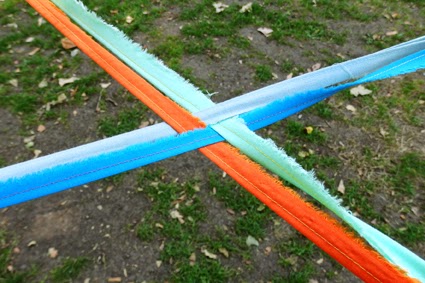
No diagrams or graphic scores were used for developing the dance on this occasion - see previous posts. After only three rehearsals, where elements of previous dances were reworked and moves developed, I handed the written score below to the dancers. The picture above however, with the four sticks placed in something close to a windmill plait, goes a long way in illustrating the turns and crosses in the latter part of the score and I might have saved myself the trouble of writing all of it. Reading objects instead of writing scores might be the new approach for creating yet new dances... Now there's a thought!


Score for Bobbin Dance #4 (Weaver's Delight & Winding the Bobbins)

a.    Dancers walk in to the dancing area one by one, four of them holding a stick, followed by the fiddler playing Weaver’s Delight
b.    Dancers meander freely, gradually stepping in synch to the rhythm of the music
c.    Dancers form in a circle, walking equally spaced around the fiddler now standing in the middle of the performing area
d.    The dancer without the stick (dancer [A]) does a U-turn, walking in the opposite direction and weaving between the others (dancers [B] to [E]), collecting sticks as he/she passes by each of them, by left and right shoulder alternatively, and then hands the sticks back to them in the same way. This is repeated 3 or 4 times.
e.    Dancer [A] walks one final round collecting all the sticks and places them in cross formation at the feet of the fiddler and then rejoins the circle. All five dancers circle in the same direction around the fiddler.
f.     Dancer [B] pick up a bobbin and ribbon from the fiddler, unwinding it and taking position in front and to the right of the fiddler
g.    Dancers [C] to [E] follow suit, each raking place to the right of the previous dancer, spaced approximately 1m apart, forming an arc of a circle in front of the fiddler
h.   Dancers [B] to [E] each raise and lower their bobbins and ribbon to allow dancer [A] to walk underneath them for a few more rounds (Mexican wave effect)
i.      Dancer [A] then takes the bobbin from dancer [B] and starts all dancers weaving with the bobbins: a number of 'turns' and 'crosses' are performed (see previous post), with one floating dancer exiting and re-entering the set of four bobbins/dancers with each 'turn' and 'cross'
j.     Music fades as the weaving becomes more rhythmical and mechanical, eventually stopping while the dancers weave on
k.    Music picks up again, dancers still weaving
l.      Dancer [A] then collects bobbins and circles around the fiddler as the tune played changes to Winding the Bobbins
m. All circle around fiddler as dancer [A] ties bobbins around the fiddler’s waist
n.   Dancer [A] rejoins circle giving dancer [B] a cue to lead out
o.    All exit, last to leave is the fiddler, still playing
p.    Music stops, clapping, walk back in, bow and exit


Fiddler's woven sash, wound up and
ready to be strapped up again

Tuesday, 30 September 2014

Protest and production in song (and dance)

Liz Hoggard's review of Yan Tan Tethera in Crafts Magazine,
September/October 2014, issue #250
(a taster in four extracts)


For further reading / copy of magazine, visit
http://www.craftscouncil.org.uk/magazine/issues/


Friday, 29 August 2014

Bobbin Dancing @ Yan Tan Tethera (part 3/3)

'We discover performance by making it' 
- Goat Island performance ensemble

It’s fair to say Bobbin Dance #3 was a real challenge. With fewer dancers available, each of us danced with two bobbins instead of one. Given the complexities of working with these (i.e. winding and unwinding pairs of bobbins in time with the music) and the limited number of rehearsals scheduled, this was probably not the wisest of choices.

The dance was performed in the garden, starting this time dancing a straight hey around two rows of fencing pins, from one end to the other using sticks only. We then 'upgraded' to wooden bobbins with ribbon, and five of us proceeded to weave something close to a 'fond the torchon' stitch with our 10 bobbins, accompanied by Ben Moss on the fiddle. Sketches used as scores in the previous dances (see previous post) seemed ineffective when holding two bobbins each, so I drew up the score below.


In comparison with the two previous dances, this one seemed to be more about the handling of the bobbins and less about dancing. We forgot about our bodies and how we moved as we grappled with the mechanics of handling the bobbins and ribbons.

photo Fay McNulty
photo Faye McNulty

So where to go from here? What elements of the dances should be reworked, cut back or explored further? Should we maybe dance without thread and bobbins? Might we present the work as an installation instead of a performance and show the weaving of the piece as film (the do-si-do, passing by right and left, figures of eight, circular and straight heys, turns and crosses, fond the torchon, Brussels stitch)? Should the performance be more of a durational work, allowing more ‘fabric’ to be woven as suggested by one of the dancers? Should the music follow the sound of the bobbins rather than leading them?


So many questions needing answers... As the work was developed with the dancers, I'll now put these questions to them. I doubt we’ll reach a consensus, but we’ll then be in a better position to proceed with making informed decisions for the final performance and event of Yan Tan Tethera.  Will keep you posted on this...


Meanwhile I'll seize here the opportunity here to thank again to all the bobbin dancers who helped make this work possible. They are Chloe Metcalfe, Jess Smulders-Cohen, Julia Manheim, Odette O’Reilly, Pallavi Jain, Ruth Bradshaw, Tina Götschi, Vanessa Trotter, Vicky Harrison, Weiyee Cheung and Zoë Gilmour. A special thank you also goes to Ben Moss and Aimée Leonard for providing the music and their encouragement throughout, as well as singers from the Cecil Sharp and Dulwich Folk choirs.


Bobbin Dancing @ Yan Tan Tethera (part 2/3)


When dancing around the Maypole, ribbons wrap around its length from the top down to create the 'weave'. When making bobbin lace, stitches are spaced out using pins on a pillow. Both the pole and the pins and pillow allow the weaving and lace making to grow. Dancing with only bobbins offers no such luxury; only a limited number of 'turns' and 'crosses' (see previous post) can be made before the threads twist over each other and the pattern disappears.


The question was then how to make the dance long enough to match the duration of the song we would be dancing to.  We explored various ways of doing this. We switched from using bobbins with fixed lengths of rope to using bobbins with handmade ribbon, the length of which could be unwound at will, allowing us to travel away from and extend the weave. This offered many more possibilities and resulted in two dances being created.


Following the performance of a circular hey, also described in the previous post, Bobbin Dance #1 split dancers into two groups of four. Stepping in opposite directions and now performing something close to a straight hey, the dancers wove their bobbins to the tune of Off Jumps Jack and Yan Tan Tethera, sung by the Cecil Sharp House and Dulwich Folk choirs. This a created a four-way plait worked simultaneously in both directions.


In Bobbin Dance #2, six dancers all stepped in the same direction, 'turning' and 'crossing' their bobbins and eventually weaving around two rows of singers performing do si dos and straight heys. The dance floor became a 'lace pillow' (with  the singers as ‘pins’) onto which a network of knots was created.

photo Fay McNulty
photo Faye McNulty
photo Fay McNulty

To rehearse the dances, various scores were produced to help memorise the moves, as illustrated below. More on this and Bobbin Dance #3 in my next post on this blog.


Thursday, 28 August 2014

Bobbin Dancing @ Yan Tan Tethera (part 1/3)


When thinking of folk dance and weaving (see previous post), Maypole dancing is an obvious reference and, practicing this in the initial stages of developing the bobbin dances for Yan Tan Tethera seemed inevitable.


During early rehearsals when developing the dances, accompanied by Ben Moss on the fiddle and later Aimée Leonard on the drum, we danced as in around a maypole, i.e. forming two concentric circles that moved in opposite directions - see drawing above of a Circular Hey, from Cecil Sharp’s Country Dance book. 

Holding handmade bobbins, dancers crossed each by the left and right shoulder alternatively and weaved the knots pictured below. Images on the left are a knots 'danced' with 6 bobbins, and on the right with 8 .


Music helped both the dancing and the weaving. It made us step in unison and keep our positions and helped produce a regular weave. This in turn allowed us to undo the knots by simply reversing the steps and repeating the process in order to explore pattern variations; holding the bobbin up or down for instance as you crossed one another (either by left or right shoulder) meant a dramatic change in the pattern (or weave). We later referred to these specific ways of crossing the bobbins in terms of a ‘turn’ or a ‘cross', terminology used when making bobbin lace - see my own explanatory diagrams and score below.

Practicing these steps and figures with bobbins highlighted a clear connection between folk dance and textiles and these were used at the beginning of the first 'bobbin dance' performed during Museum Night on May 15th at Cecil Sharp House. I'll describe in my next post what came next.


Lace Tell @ Yan Tan Tethera


Time to retrace my steps a little…  A few months ago I was asked to contribute work for Yan Tan Tethera. Curated by David Littler in partnership with The English Folk Dance and Song Society, the exhibition looked at the connections between folk songs and textiles. My interest from the start was to focus not on songs, but dance. Thinking of it as a making process, I envisaged dancers working with yarn to produce stitches and knots, to be read as some form of dance score or notation - see previous post.


Fast forward to the present and with the help of a number of participants, I have now created four dances, a site specific installation and a series of objects and drawings that are currently on display in the exhibition. I'm now planning a final dance piece and to help with this, the following posts will reflect on what I've done so far.

With some of my previous installations such as Stairwell Weave-In in mind, I saw at Cecil Sharp House some potential to have performers sing as they stitched and stepped up the staircase, using the bannisters as a loom. During an early recce at the venue, David handed me a few songs from the EFDSS collection, including 'Lace Tell', a work song often sung by women while making lace.


The outcome resulted in 8 dancers working a single row of stitches each across three floors to the tune of this 'tell'. It was sung by 6 members of the Dulwich Folk and Cecil Sharp House choirs. Many thanks to Aimée Leonard, Sally Davies, Sarah Maddon, Jenny Tompson, Ian Kennedy and Sarah Lloyd for this. Over 20 minutes, the stairs gradually filled up with an audience as the stairwell filled with stitches. Two other dances were also performed that evening during Museum Night at Cecil Sharp House and I'll write about these in the next post. Read also more about this in Liz Hoggard's review of the show in Crafts Magazine September/October 2014 edition.


photo Roswitha Chesher