Showing posts with label cording. Show all posts

Sunday, 17 December 2017

How twine changed the course of humanity completely and forever...


'It probably happened like this, some 40,000 years ago… 

Man, might have been a woman, twisted strands of grasses together and made twine for the first time. Cording was invented. The twine made was used to tie sticks together, then longer lengths of it woven together to make coiled baskets. Where grasses were not so abundant other plant materials were used such as bamboo in Asia, willow in Europe or palm fronds in the Pacific. With the use of different materials, techniques were adapted to make the most of these such as plaiting, stake and stand and numerous other weaving techniques from basketry to textiles.

The use of baskets was revolutionary. With their use, communities were able to switch from hunting and gathering to a more agrarian and sedentary way of life. For the first time food stuff, grain and other goods could now be stored, transported and exchanged; basketry (and making twine) led to advent of trade and commerce.'

- inspired by a conversation with Eva Sajovic talking about reason for wanting to show a large piece of rope made from corded waste plastic at Danielle Arnaud Gallery next year, as well as Barry Flanagan's work currently exhibited in the Duveen Gallery, Tate Britain.


 (Photos above are included in the cording chapter of Practical Basketry Techniques

Wednesday, 5 July 2017

string for sittard

step #1

Above and below are step by step instruction showing you how to cord. These are to be included in a forthcoming publication featuring a project of mine, part of Cultuur maak(t) je, a programme of event and exhibitions at De Domijnen curated by Joanna van der Zanden and Jeanne Van Heeswijk. More info on the project here.

Natural fibres would traditionally be used to cord yarn or twine but recycled plastic bags, cut into strips, would be ideal for this too - see previous post. Have fun experimenting with this while doing your bit to save our oceans from plastic pollution.

step #2

step #3

step #4

step #5

Monday, 2 December 2013

repetition is the mother of invention

Dailymade #131120

Over two years into posting one dailymade a day and with nearly 800 of these under my belt, the thought that I am starting to repeat myself has crossed my mind a few times.  Recent work however has put this worry to rest.

Dailymade #131119

A couple of weeks ago I started reusing sisal twine which I have an abundance of in the studio. The plan was to make doilies with the coarse twine, but what happened between start of the process (always the same sequence of 6 stitches looped into a circle) and the finish (when my 10m bundle was used up) resulted in a different outcome every time. The instruction I set for myself inevitably seem to lead to freeform making and the range of objects you see illustrated above and below. 

Dailymade #131122

Sure, I could have been stricter with myself and stuck to an exact pattern, but I decided instead to a keep soft focus on what I intended to make and 'riff' with the material. As a result repeating the same simple tying and knotting manoeuvres lead to much innovation and discovery. So, worrying about posting the same old dailymades, I don’t see it happening any time soon...

Dailymade #131121

Wednesday, 17 October 2012

Stave Hill study day


Back at Stave Hill Ecological Park last week with a group of first year 3D design students from Camberwell College of Art.  I suggested going there only recently to my Intelligent Trouble collaborators but they didn’t take to it, so it was good to go there on a bright and sunny autumnal day and do some making with my students. 


twining with spindle and willow and rosehips

The day started with Rebecca Clark, who  runs the team at Stave Hill, giving us a tour of the park and pointing out plants we could use  to weave with.  Much coppicing has happened there since my last visit there and the park looked very different.  The hops were high and provided plenty of flexible and lengthy material to weave with.  They proved handy to split too.  Wish I’d taken a picture of these... 


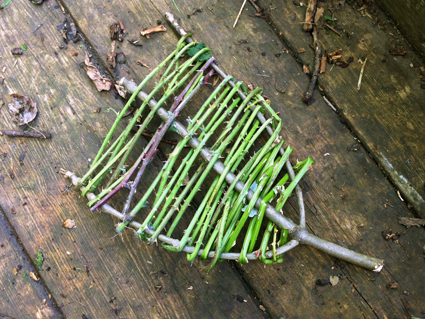
weaving a stool with hedgerow materials

The idea was for the students to make interventions on site.  However, following an active foraging session, a purposefully short introduction to cording and twining and a cup of tea, they all got stuck in and produced the various constructions illustrated here.  We ran out of time to make our interventions. I’ll just have to plan a two day workshop next time so we have time to install things in situ and so  surprise joggers, dogwalkers and nature lovers who frequent the park.


twined hedgerow materials including brambles,
hops, cherry and willow

I deliberately kept the imparting of technical know how down to a minimum, so students had the chance to familiarise themselves with the materials they were using in their own way, and rely on their own specific ways of making and constructing.  Less information often means more in this case, and the feedback overall was very good at the end of the day.  Note to myself, I must do this more often...


plaiting with willow and cording with ash leaves