Showing posts with label hedgerow basketry. Show all posts

Monday, 20 October 2014

Brancusi baskets


Last Saturday somehow felt life the first day of the rest of my life. It was the first official day of my artist’s residency at Stave Hill Ecological Park (see also First Moves post) and I spent the day there working by the water, with Chris, cutting brambles in order to weave with these.


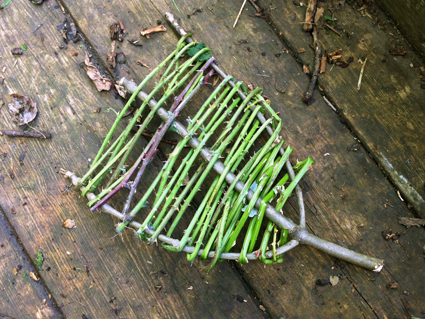
We made twined constructions,inspired by my recent project in Darlington, with view of stacking these vertically to create a tall column. Conical in shape and joined tip to tip and base to base in a repeated abstract pattern, the woven piece would some kind of homage to one of my favorite ever sculptures, Brancusi’s Endless Column.

This project didn't exactly go to plan as we ran out of time to produce enough of the twined pieces and install these, skewered on a large pole, in what seemed an ideal spot in the middle of the pond. I did I take off my shoes, rolled up my trousers and waded in, but couldn’t get the post to stand up securely. Luckily Chris missed in the opportunity to record the whole messy business on camera, so my dignity still remains intact, for now. It's only a matter of 'chose remise' however as I’ll have another bash at it next week. I can’t wait, especially as the trees have started changing colour and did look glorious in the autumn evening sun. A gorgeous sight indeed!


In the meanwhile, I did try other ways of installing the woven pieces, but couldn’t decide on where best to place work, this probably on account of not having enough of them to stack up. What we need it seems is another 50+ items to achieve a sizeable height for the sculpture. As there is no shortage of brambles on site, this could easily be done. The great thing about stacking these as illustrated above, is it will allows viewers to peek into holes in through the centre of the weaving at different heights and in different directions, framing the view of the park, its surrounding and the sky above.

As we are yet still to see the Brancusi inspired column emerge from the water, it seems a second project at Stave Hill is already on it way. Keep you posted on this…


Saturday, 18 October 2014

The Darlington Post


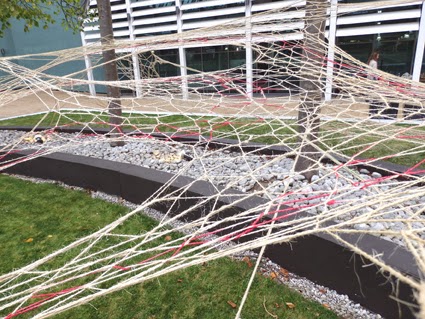
Here is a visual account of the installation at the Festival of Thrift and some of the twined baskets produced by visitors at the event. 


Three kilometres of sisal twine, a few days to stitch the installation, heaps of green materials, more sisal and yarn still to twine with, involvement from numerous, help from volunteers and well of course as the assistance from the Festival of Thrift's great team and Home Live Art, is all it took to achieve this! A fantastic experience all round and I certainly look forward to going up there again in a few weeks for another outdoor project in the making...


Highlights of the Festival of Thrift weekend? The Disco Bingo girls, thinking about landscape gardening courtesy of Nu-urban Gardeners, hearing but not having to dance the Lambeth Walk lead by Ida Barr during her now world famous Mash Up and meeting all those friendly Darlingtonians to name but a few things. Last but not least I have to add scything reeds and bulrushes in the nature reserve near Lingfield Point when foraging for materials to weave. This was done with the help of Peter and Tim (pictured below). Thanks to them and also to Stella, Alex and David who brought in clematis, willow, crocosmia and peony stems, as well as all the kids fro the nearby school who contributed their gorgeous twined constructions for the occasion.


Wednesday, 13 August 2014

Art - don't use!


The Festival of Thrift instructible posted a couple of weeks ago on this blog, with instructions for twining with sticks and string, might have left you wondering what the object could be used for? Is it art? Is it design? If the Festival of Thrift is about celebrating upcycling and sustainable living, what is the point of making something that doesn’t have a function, no matter how green or economical the use of materials for its production are?

Well, art does fulfil a very basic human need and if you’ve made something, if only to look at, that is functional enough for me. The picture above is something I spotted outside the Czech Pavilion at the Venice Architecture Biennial a few days ago which, with humour, highlights this issue.

However, to put your sustainable minds at ease, I’ve turned the modernist principle of 'form follows function' on its head, and thought of a few uses for the original instructible…

·      fill the twined construction with seeds and nuts and use it as a birdfeeder
·      alternatively use it as a cover for a fat ball by threading and suspending the ball inside the cone 
·      use an apple instead of the a fat ball (see bottom picture) to feed your feathery friends, or use a pompom from which birds might pull threads and use in their nests for added warmth and comfort (see instructions below)
·      with a larger twined construction, use it as a hanging basket for plants by lining the inside with fabric or paper
·      finally, how about using it as a lampshade, using a low voltage bulb to prevent any fire hazard


Pompom making (a speedy method)


Wrap several yarns around your fingers, slightly spread.


Bring fingers together to release the bundle from your hand. Wrap the yarn tightly at least twice around its middle before tying and cutting off the yarn, 10 inches / 25cms approximately from the bundle - you'll be using this length to attach the pompom to the twined cone.


Cut the threads on either side of the bundle.


Fluff up and trim off the longer bits to make the pompom more regular.


Et voila!  Job done once again! 


For additional sources of inspiration on making bird-feeders and/or hanging baskets, click here and here.

Apple feeders for birds, better still with sunflower seeds
pushed into the fruits - click here for more pictures.

Friday, 25 July 2014

ready steady weave (Festival of Thrift instructible)


Writing... at last!  It has been over three months since the last post on this blog, and weekly weaves has almost become quarterly weaves. That will no longer be however, though I have enjoyed the break. I will report on my recent creative endeavours in the next few weeks, of which there are many.  Meanwhile, here is an ‘instructible’ for a forthcoming project at the Festival of Thrift taking place this September in Darlington.


Commissioned through Home Live Art, the project involves creating an architecturally sized sculptural installation, stitched between trees and buildings at Lingfield Point.  The stitching will provide a framework for hanging woven objects made by visitors at the festival, using locally sourced natural materials and green waste combined with yarn.

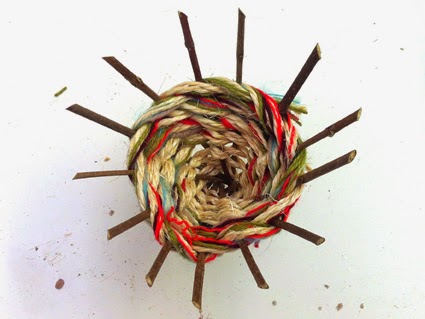
The instructible below which should take about 5 to 10 minutes to make is one idea of several in development, for objects that could be produced by visitors to furnish the installation. The technique introduced here is twining, probably the oldest form of basketry and a skill related to what lead to the advent of the first baskets and buildings made by man. For more info see this previous post as well as others on this blog inspired by hedgerow basketry.

Whether the objects to be produced end up being templates for hanging baskets, bird feeders or  simply  decorations, the making of these by some of the 27,000 visitors expected at the festival (!) should be fun, entertaining, inspiring and bring home the fact that most of the stuff that surrounds you, including the growing varieties, can be used creatively. 

So, why not give it a go and come prepared to the festival by making one or several of these to add to the display.  There will be more instructibles posted here very soon. Keep your eyes peeled!


Recipe

To make a twined construction as those illustrated above, you’ll need 10/12 sticks, secateurs (optional), multi coloured string or yarn, an elastic band, a crochet hook (optional) and a pair of scissors.


Cut all the sticks to an equal length, approximately 12 inches / 30cm. Bundle them up using the elastic band making sure to arrange tips (thin ends) on one side and butts (fat ends) on the other. Try use sticks of similar thickness if you can.


Cut a 1/1.5m length of string/yarn. With the tips at the bottom, fold the length in half and loop over one stick as illustrated above. 


Bring the length of string on the right hand side of the stick over the front and loop over the back of the next one on its left. You are now twining!


Twine around all the sticks repeating this process.  These instructions by the way will mostly suit  left-handed people like me, that is twining round the bundle in a clockwise direction. If you are right handed, try reverse the direction you are working in, i.e. twining anti-clockwise.


Notice that as you twine the sticks will want to twist in one direction with the sticks coming apart.  Allow this to happen freely. The wider the gaps, the wider the opening of the 'basket' you are making will be. 


Notice also that one or several sticks will naturally find themselves in the middle as you have twined a full circle round the bundle. It’s up to you whether you want to weave these in by twining around them in between other sticks or remove them.


As the gaps get bigger, add more yarn as illustrated above to fill these in.


To finish, trim the yarn on the right hand side of the last stick have worked one inch from the weave.


Thread the remaining bunch underneath the last round of twining using a crochet hook if you have one. If not, prise the weave apart using fingers to hook the yarn through and trim 1 inch from the weave.


Last, cut the sticks at the top and bottom.


Et voila! Job done!

Saturday, 22 June 2013

go green, go fresh, go wild!

Hop tops, delicious steamed with a little butter! 

Unusually cold weather has meant spring was delayed this year with opportunities for picking seasonal wild food being somehow prolonged. Not a bad thing all in all...


A few weeks ago the young shoots of alexanders found in local parks near me could be picked, steamed and eaten much like asparagus. Now they are far too woody. You can still taste their amazing aroma, but only after chewing the pith as you would with a stick of licorice, so it’s hardly worth the trouble.  Apparently if you peel and fry them, they tenderise, and the flowers can be eaten too, but I haven't tried this yet. The wild garlic has all but gone now, but I managed to find some three-cornered garlic the other day, though very much on its last legs. The leaves are delicious, and the flowers are great in a vase!


Wild garlic
Three cornered garlic

Hops are on the attack at the moment, creeping over whatever they can in competition with the bindweed.  The are tasty with butter and pepper after a little steaming.  Don’t be tempted to cut more than 10” from the end though, as you’ll have the same problem as with the Alexanders. The garlic mustard (or Jack-by-the-hedge) is blooming at the moment and ripe for picking, as is the ground elder. 

Garlic mustard
Comfrey

More foraging and culinary tips can be found in Roger Phillips’ Wild Food book, which is has been my bible when out and about looking for lunch. Richard Mabey’s Food for Free publication is great too, and pocket sized which is helpful.  I never leave home without it these days.


Nettle pith and twined bark

Off to pick some nettles now, which turn out to be most useful of plants: use the top leaves to make soup or pesto (using almonds instead of pine nuts), the older leaves to make blue/green dye, and use the bark and pith for cordage and basket weaving.  The plant is a good diuretic and also combats the symptoms of hay fever. Not sure what to do with the roots yet, but will get back to you as soon as I know.


See you are what you weave, make bindweed a bonus and sycamore is for curiosity for more info on edible plants and hedgerow basketry.


Wednesday, 17 October 2012

Stave Hill study day


Back at Stave Hill Ecological Park last week with a group of first year 3D design students from Camberwell College of Art.  I suggested going there only recently to my Intelligent Trouble collaborators but they didn’t take to it, so it was good to go there on a bright and sunny autumnal day and do some making with my students. 


twining with spindle and willow and rosehips

The day started with Rebecca Clark, who  runs the team at Stave Hill, giving us a tour of the park and pointing out plants we could use  to weave with.  Much coppicing has happened there since my last visit there and the park looked very different.  The hops were high and provided plenty of flexible and lengthy material to weave with.  They proved handy to split too.  Wish I’d taken a picture of these... 


weaving a stool with hedgerow materials

The idea was for the students to make interventions on site.  However, following an active foraging session, a purposefully short introduction to cording and twining and a cup of tea, they all got stuck in and produced the various constructions illustrated here.  We ran out of time to make our interventions. I’ll just have to plan a two day workshop next time so we have time to install things in situ and so  surprise joggers, dogwalkers and nature lovers who frequent the park.


twined hedgerow materials including brambles,
hops, cherry and willow

I deliberately kept the imparting of technical know how down to a minimum, so students had the chance to familiarise themselves with the materials they were using in their own way, and rely on their own specific ways of making and constructing.  Less information often means more in this case, and the feedback overall was very good at the end of the day.  Note to myself, I must do this more often...


plaiting with willow and cording with ash leaves