Showing posts with label participation. Show all posts

Sunday, 16 November 2014

The Whitechapel Gallery talk (added value re-write)

Stairwell Weave-In, Dovecot Studios, Edinburgh

Remaking means added value. It's something I addressed at the talk I delivered last Thursday at the Whitechapel Gallery, part of the Real World series of talks curated by Orlagh Woods for Artquest. In the light of this I’ve decided to re-write my notes and publish them here. This partly for myself, but also for those who couldn’t attend the event which did sell out. I’m doing this in the form on a Q+A, asking myself questions and answering them. The topic of the talk was how do artist manage the boundaries of art and craft and how are these practices shifting and evolving.
Shane, how do you negotiate the boundaries between art and craft?
Badly. My work is often perceived in a fine art context as being too crafty and in a craft context as being too messy. Meanwhile Crafts magazine in a recent review referred to me as a performance artist. So, I’m either terrible at negotiating these boundaries or an expert at it. You can be the arbiters of this.


Are these boundaries useful anyway?
Yes, at least to know when and where to step over them. Glenn Adamson in his book Thinking Through Craft puts a solid argument for these to be clearly defined so we're able to use them as a filter to understand what we are looking at. 
How do you define these then?
How much time do we have? An answer to this can only lead to endless debating, but here goes… My feeling is that craft objects have to refer in some way to the process of their own making, while art objects don’t. Art prompts you to look at it from another point of view than how the object is made. My interest in process over product is probably why my work is perceived as craft. The boundaries are porous of course, and it is always worthwhile looking outside your own practice to reinvent it and push your work forward. Someone told me recently that this question of boundaries will only be of real concern to crafts people and not fine artists. A perceptive comment I think. Rather than think about how to define art vs. craft, better to think of how to identify with either. Key to this is context and presentation, which qualifies what we are looking at and how we experience it.


Tell us more?
Objects are not revealed to us by looking only but through interaction. The value of objects all too often gets in the way of this interaction. What do you know of a pot unless you hold it in your hands after all? Art ought not simply to be about communicating ideas but also to convey experiences. We’re not just brains on sticks; we need to relate bodily to objects. The preciousness of objects starts working against them, requiring them to be displayed on plinths, vitrines, cords to separate them from their audience. One of Richard Tuttle's pieces in the current exhibition apparently required two first class seats (one for the artwork, one for the courier) to be shipped from the States to London. Getting up close and interacting with this object in this case is of course impossible and probably why the artist himself prefers his work to be shown in a domestic rather than a gallery or museum context.

Making by Instruction workshop at The Poly, Falmouth

What are the answers then?
Adopting participatory approaches when making and showing work, engaging audiences with processes and materials of making rather than presenting them for the sole purpose of being looked at. Daniel Miller writes ‘objects don’t matter, it’s what you do with them that matters’. Pioneers of participatory work talk about how ‘the object has lost it’s significance unless it is a mediator for participation’ (Lygia Clark). Helio Oiticica states ‘a work should range from the givens (things already produced), to the livings (the route to be traced by audience) and the transformable givens (the objects that demands inventive participation from the creator)'. There are many reasons why I have chosen to do participatory works over the past 10 years and one of them is to enrich the connection between object and audience. 
Another strategy might be to do away with objects altogether. Objects don’t last forever (taking a larger historical perspective on this) and can always be remade. I’m very interested in the process of making by instruction and the process of interpretation that goes on as work is reproduced. Value can be added to an original work as it is remade and therefore reinterpreted. So why not keep instructions and scores rather than the objects themselves and involve artists and audiences in the remaking of these? This is after all is common practice in dance, theatre, music. Why not art?


Knitting Piece #11, Prague Biennial

Isn’t the answer obvious? Not everyone can paint Monet’s Waterlilies.
True. There is of course a case for safeguarding artworks, but the use of plinths and vitrines, despite being an issue for half a century or more, still needs addressing I think. Thinking about this I’ve been looking again at the work of Phyllida Barlow, and reading her ‘Hatred of the Object’ essay, where she denounces the use of vitrines – they deaden work, make it safe, clean, polite. Her work embraces fully the sculptural over the pictorial. It celebrates making and materials in all its mess, awkwardness but also subtleties. Barlow never looses sight of the temporality of sculpture, celebrating how things fall apart, rot, melt and disintegrate. The making of her sculptures and installations, or elements of these, are often rehearsed and then performed in situ to create the work. After being displayed they are dismantled and parts reused for making other work. I love the ecology of this. I also love how these monumental works carefully calibrate the relationship between space, body and object, carefully considering what materials can do for a space as well as the people in it.

rehearsing Garland #21 with
Cheryl McChesney Jones at Siobhan Davies Dance Studios

Is there then an ideal model for displaying craft?
I’m not sure about a model but a guideline could be to think about what André Lepecki describes as the constitutive qualities of dance: ephemerality, precariousness, corporeality and scoring.
Thank you very much Shane. Let’s hand it over now to the audience now. Are there any questions?

Lacetell performance at Yan Tan Tethera, Cecil Sharp House

Thursday, 29 August 2013

it ain't nothing without you...

'Art isn't what you make, but what you make happen'
- Jeremy Deller

When working on participatory projects, the challenge always is to know how much information to impart to the participants. Saying too much can result in diminished creative input from the group. So how do you get the most from the participants? How do you best capitalise on their creative ambitions while also managing artistic control over the piece? How do you make on the spot decisions when exploring new creative ideas? These are some of the questions I asked myself during the Delve Deeper Intensive with Helen Carnac and Laïla Diallo last month at Siobhan Davies.

Choreographers by nature of their work are likely to be more familiar with this than other artists. I was most impressed with Laïla’s delivery of various tasks she set to the group: economical, measured, open ended.  It prevented us from ‘end-gaming’ what the outcome would be and helped us embrace the unexpected while also valuing the minutiae of whatever we were doing.


A large part of my installation in the Make Believe exhibition at Nottingham Castle, separate from the weaving between trees (see previous post), involved using fencing pins in the lawn, as you would pins in a lace pillow, to produce ‘lace’ around the grounds of the castle.


To prepare for this I practiced various stitches in the studio on an actual lace pillow and drew up a pattern to follow when making the work on site.  However as soon as we started, the pattern had to be scrapped. The action of working the sisal twine using custom made bobbins to cover the grounds lead me to rework the pattern I had and make up new stitches as we worked our way across the lawn.  What guided me through this was allowing the participants to find their own way of working with the materials and each other. This improvised method, based on set manoeuvres, proved the best way of making the ‘lace’ in the end.


It’s nice to think that with a different group, the outcome would have been very different, and without anyone, the piece could not have been realized at all.


Sunday, 9 June 2013

knots for Notts


I spent two glorious days in the sun the week before last in the grounds of Nottingham Castle, overlooking the city and rehearsing the making of my next installation for the museum’s forthcoming exhibition Make Believe: re-imagining history and landscape.


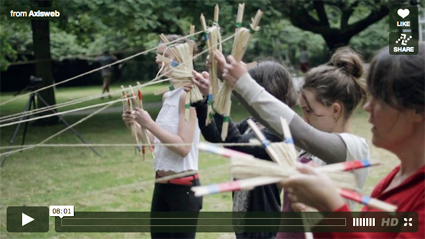
The city’s history and connection with lace making informed my contribution to the exhibition: a large scale lace installation created on the lawn around the castle using fencing pins and rope. Helped by three assistants and a group of enthusiastic volunteers, we rehearsed the making of the piece by using our fingers and hands to stitch between trees. We then proceeded to do something close to formation dancing, acting as human bobbins, holding lengths of yarn and winding these around the (metal fencing) pins as you would on a lace pillow. Click here for footage of the rehearsal on the Fermynwoods Contemporary Art website.


Many possibilities and challenges were revealed as we worked and talked about what we were doing and at the end of the two days, I came away from from the activity with a head full of ideas which I’m now processing. I’ve now ordered nearly two hundred fencing pins and can’t wait for the next time I am up there with this lovely group.


Thanks so much to all the volunteers who helped rehearsing the piece, and to my assistants Jess, Sarah and Rossella.  You were all great!


Saturday, 14 July 2012

walking piece


I’ve worked myself up into a state of excited anticipation sending out a group email recently with details of Matthias Sperling’s Walking Piece, which I’m performing at Siobhan Davies Studios as part of the Footfall event tomorrow.  Walking Piece is an installation performance where a diverse group of performers come together to create a single-file loop that continuously circumnavigates the building, passing through a score of playful performative tasks along the way.

I got involved in the project for various reasons.  I was intrigued by its title. Walking is such an ordinary thing, most of us do it, usually without thinking about it. But when you do start thinking about it, it does become rather extraordinary. Walking is not just about moving, it is also about thinking, making a connection with place and site, and also communicating in a social context.


The other reason for getting involved is I recently created a site specific installation at the studios.  A group of three dancers walked up and down the staircase using the metal framework as a device to weave on (click here of details and see previous posts on this blog). I also used the outdoor staircase during the project, so the parallels with Matthias’ piece intrigued me. I am interested in the performance of craft, site responsive approaches to making and developing work and participation, so was curious to get an insight into his way of working. 

Ready Steady Stitch (bobbin lace) #3
Siobhan Davies Studios architectural plan for
staircase, thread & pins on foam
It’s my first time doing anything of this kind.  I did take off all my clothes for one of Spencer Tunick’s human installation a few years back, accompanied by 1000 other people, but it hardly compares.  It’s also been a while since I’ve taken a dance class. After 10+ rehearsals, Walking Piece does feel very familiar.  However, each time we’ve run through it at rehearsal, it feels like it is being reinvented.  This comes from having to perform tasks rather than remember sequences of actions and movements as we walk through the building. The meaning is in the moment, acting in the present rather than re enacting the past. It is a live exchange between the building, the performers and the audience, and I very much look forward to the ‘reinvention’ of the work happening tomorrow.  Performing Walking Piece throughout the day will be like performing it for the first time again, and again, and again…

This is a radical approach for a maker, and I love it!  It resonates with my own practice where I consider the process as much as product, and prompt social interaction through making rather than simply looking at art.  In Walking Piece, the social dimension of the work is essential.  The tasks become meaningless without interaction from others and become almost impossible to perform.

It’s been fascinating to see Matthias at work, and see how he has shaped the piece over the few weeks of rehearsals, responding to how we performed the tasks and then tweaking his instructions to us on what our intentions might be when performing these.  Much food for thought…  I’ve truly taken my head as well as my feet for a walk, and gained trim legs in the process!

Desire Line #3, 2011
jute twine
site specific installation piece in Fermynwoods, 2011


Saturday, 21 January 2012

stitch / script


If choreography is designing ideas, emotions or narratives through movement, what of the objects created as a result of these movements? The installation Stairwell Suite (see previous post) at Siobhan Davies is made up of string held by dancers as they moved up and down the spiral staircase at the studios. The web like structure is the intermeshing of traces describing their movements. Can this be seen as a notation of the dance, or a physical translation of the ideas communicated through it? This is the question I’ve asked myself and invite the viewer to reflect upon when encountering the installation and accompanying film which features selected moments of the performance.


An insight to answer this question lies in the wall piece Stitching Score #1 (top 2 images) installed on the first floor. The piece consists of a 200+ meter long string of fabric, produced during Stitching Revolutions, an interactive project at Alexandra Palace, London, in 2010. This involved six people operating overlocking machines that cut and stitched the clothing together simultaneously. Arranged in a daisy chain formation, a silent conversation was had between the stitchers as fabric was fed from one machine to the next. The fabric, installed in horizontal lines, is shown as a record of the making activity and prompts the viewer to read these as a piece of notation, with its own unique grammar and symbols made up of stitch, thread and cloth. Not such a strange idea given the word ‘text’ comes from the latin textere, meaning ‘to weave’, and the word ‘line’ comes from linea, meaning a thread made from flax. Quoting Tim Ingold once again from Lines: A brief History - ‘if ‘line’ began as a thread rather than a trace, so did ‘text’ begin as a meshwork of interwoven threads rather than of inscribed traces’. This knowledge sheds a new understanding on both Stitching Score #1 and Stairwell Suite.


I periodically exhibit stitched, knotted and woven fabric pieces such as the Knitting Pieces or Garland series that result from similar communal making endeavours. With each install, the fabric is inevitably transformed and reveals new textures and surfaces as the weaving is further intermeshed or stretched out. The pieces have no fixed form or shape and chance determines to a large part their final appearance. Their narrative is thus constantly transformed, though ultimately these can only refer to the objects themselves, which the viewer interprets based on their own relationships to materials and processes. The work means nothing outside the perception of the object itself and, as with most text, meaning is often read between the lines.


On Friday 24th there will be a late night public stitching and weaving event at the exhibition. Click here for details. Lost property items left at the dance studios will be stitched on overlocking machines by members of the public, and weaving will take place in the stairwell, adding yet more content to the scripts and scores already displayed in the exhibition.

Saturday, 14 January 2012

cross it this way, and that way, and pass it on…


Anything can be made out of anything, and in a limitless number of ways. ‘Stuff’ is what draws a lot of people to art, and how it is all put together. To get them engaged with it, have them make something - making is inclusive, making is empowering.

A good number of projects of mine have relied on participation for this reason. I’ve created spaces where the public are invited to make collectively. My involvement with the knitting collective Cast Off, and the Craft Rocks event at the Victoria and Albert Museum in London in 2003, led me to conceive the ongoing Knitting Pieces and Garlands series of works. Whether stitching a circle or weaving an installation, these activities prompt social interaction and communication through the doing – looking, thinking, making, exchanging. Ideas about craft and the social and cultural histories relating to it, as well as art in general, are passed around between participants. If art is about communication, let’s make!


As far as imparting knowledge about how to make things, the less said the better. Being told exactly how to handle tools and manipulate materials is a dangerous thing. I’m interested in the Knitting Pieces and Garland installations providing a space where participants can develop their own way of doing things and their relationship with materials and processes. Making is not simply about skill and technique, but about an approach and attitude in relation to these. With this freedom, each maker is more likely to develop his/her own individual way of making.

In the light of this it is odd I've been involved in working on a book such as Practical Basketry Techniques, where set procedures are demonstrated to achieve determine outcomes such as a platter, a multifunctional bowl and hat or a plant cloche. However, projects in the book are but an introduction to processes that aim to encourage readers to get inspired and develop creative ideas. I led a 3D weaving workshop with design students recently. I urged them to bring a range of materials, and following brief demonstrations, I got them to plait and so dome interlacing. Wonders were created in no time, and I like to think their outlook of weaving and how it relates to their practice has been changed forever. The best thing to do with your know how is to pass it on. You’ll be amazed what comes back your way. I myself got so much inspiration from the session. So here is some advise: cross it this way, and that way, and pass it on…