Wednesday, 30 October 2013

collaborating with myself


‘The real issue is not how do you find your voice, but how to get rid of it’ – Phillip Glass

Can this be the benefit of creative collaboration?  Not according to Sally Potter. It’s ok to relinquish your voice if you have one, but some of us don’t have had that privilege. If you’re lucky enough to have a voice, own it and celebrate it! Collaboration is all too often an excuse to mask the embarrassment of claiming authorship for something she argues.  Mmm, now there's something to argue about…


This and other ideas on creative collaboration were shared in a panel discussion at Central St Martins, an event part of Dance Umbrella 2013 held earlier this month, where a number of speakers working across film, theatre and dance talked about the subject from directed collaboration to shared authorship. Working as I do in participatory settings, this was of interest to me and not least because of my recent involvement in a couple of projects with Entelechy Arts.

One of these is Ambient Jam, a unique programme of movement and sensory-based work with adults and young people who have profound and multiple disabilities. Many company members have physical disabilities combined with learning disabilities preventing them from expressing in words their experiences, interests and needs. In these sessions, the body and its senses provide the ways and means for expression and communication through improvisation, social dance and live movement. The multi-sensory workshops and short term projects that arise from them lead to a creative dialogue between all involved.


Contributing to these workshops, primarily as a visual artist, has challenged my understanding of what participation and creative collaboration is.  In a situation where verbal communication cannot be relied on, who facilitates what, who leads who, and whose creativity is explored isn’t so clear anymore. You have to forget what you know, loose your ‘voice’ as it were, and be completely in the ‘moment’ for the creative exchange to be meaningful. The outcome is you do find your voice in unexpected places. As the dancer and choreographer Akram Khan put it in the talk referred to above, to hear music we sometime need to stop playing and simply hold the flute to the wind.


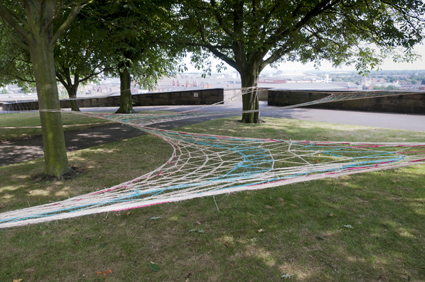
What have these pictures got to do with any of the above you may ask? Well, images of Ambient Jam can be seen on this link, meanwhile I've illustrated here images taken while dismantling my installation at Nottingham Castle. Even when working alone, we are collaborating with our memory and our acquired knowledge. The dismantling of the work led to the production of objects that were the result not only of a collaboration between myself, but also the material I worked with, the site and the weather.  The process was planned and methodical, but they were also happy accidents that were embraced and lead to what you see pictured here.


Monday, 23 September 2013

green-fingered making


I've spent a fair bit of time this last week writing a synopsis for a book on sculpture in order to meet a publisher’s deadline.  This done, I am going through some notes taken recently during landscape gardener Dan Pearson’s Sunday sermon for The School of Life at Conway Hall and drawing parallels between gardening and making. Using plant materials for weaving as I do I am already tuned in to the connection between gardening and making, but I’m now asking myself the following questions: is gardening a form of making, or is making is a form of gardening?


Dan's subject was commitment, a word which has many negative associations - obligation, liability, restriction of freedom... He proceeded to demystify this by talking us through his own associations with the word with relation gardening. Below is a transcription of the notes I took during his speech where I’ve taken the liberty to replace the word 'gardening' with 'making' (I hope Dan won't mind) in order to address the question above.


craft - practical knowledge is acquired through doing

knowledge – making shows us a slower ongoing continuity which contrasts with our increasingly fractured accumulation of knowledge

process – making completely absorbs us in an activity / process is pleasure

investment – making is rewarding in itself / making give us a sense of things being ever changing

dreaming – we make in order to dream

contemplation – making makes us appreciate slower rhythms

control – editing and deciding what is important is unavoidable when making

planning making requires you to keep an eye on the future

timing – making requires us to be in the moment as things might only happen once and for a very short period of time

sowing – making provides us with a sense of evolution

faith and hope – seeing a bright side of a wet summer (which allows things to grow and mature)

the micro and the macro – making brings together the past, the present and the future (in a borrowed landscape)

grieving making is not about beginnings or endings but about process, change and transformation / making gives you a chance to recreate yourself

acceptance – nature will claim what you have made

connection –  making connects memories and the future in unusual ways


Reading the list above I realise these provide a much needed antidote to the fetishisation of objects that is all too common in the visual arts - taking time, allowing things to grow and change, creating connections with materials, history and the environment are fundamental. Now wouldn't these topics make great chapter headings for my how-to book on making and sculpture? 

pictures above are of Dan Pearson's Long Border, 
designed for his exhibition Green Fuse at the Garden Museum,
and taken on September 1st, 2013.

Saturday, 14 September 2013

in the studio with me

portrait by David Sandison

Very nice to have thoughts about your work written by someone else for a change, so I’m seizing the opportunity to post these here, as published in The Independent on Saturday. Enough said, over to Karen Wright…

Thursday, 29 August 2013

it ain't nothing without you...

'Art isn't what you make, but what you make happen'
- Jeremy Deller

When working on participatory projects, the challenge always is to know how much information to impart to the participants. Saying too much can result in diminished creative input from the group. So how do you get the most from the participants? How do you best capitalise on their creative ambitions while also managing artistic control over the piece? How do you make on the spot decisions when exploring new creative ideas? These are some of the questions I asked myself during the Delve Deeper Intensive with Helen Carnac and Laïla Diallo last month at Siobhan Davies.

Choreographers by nature of their work are likely to be more familiar with this than other artists. I was most impressed with Laïla’s delivery of various tasks she set to the group: economical, measured, open ended.  It prevented us from ‘end-gaming’ what the outcome would be and helped us embrace the unexpected while also valuing the minutiae of whatever we were doing.


A large part of my installation in the Make Believe exhibition at Nottingham Castle, separate from the weaving between trees (see previous post), involved using fencing pins in the lawn, as you would pins in a lace pillow, to produce ‘lace’ around the grounds of the castle.


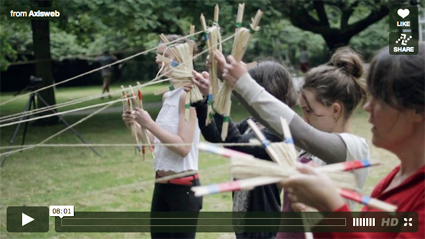
To prepare for this I practiced various stitches in the studio on an actual lace pillow and drew up a pattern to follow when making the work on site.  However as soon as we started, the pattern had to be scrapped. The action of working the sisal twine using custom made bobbins to cover the grounds lead me to rework the pattern I had and make up new stitches as we worked our way across the lawn.  What guided me through this was allowing the participants to find their own way of working with the materials and each other. This improvised method, based on set manoeuvres, proved the best way of making the ‘lace’ in the end.


It’s nice to think that with a different group, the outcome would have been very different, and without anyone, the piece could not have been realized at all.


Thursday, 15 August 2013

taking on the squirrel super-highway...


A gardener once told me the best way to catch squirrels is to hose them down with water. Their tail gets so heavy they can hardly move. You then seize that moment to throw a blanket over them and grab your humane rodent trap or shotgun, depending on your persuasion, to remove the furry vandals from your garden. Problem solved!  That’s the theory anyway…

follow the red path...
... and the blue one to the left,

My current installation Panoramic Pathways at the Nottingham Castle Museum was damaged the other week due to squirrel activity. It seems one of the stitched pathways crosses over a squirrel super-highway and some sisal was gnawed.  These furry foes hate change apparently and evidence of this on their patch is likely to be challenged.  They stop minding after a year apparently, but that’s no good to me given the work is up for a couple of months only.

duck under...
... and swoop over,
then take a breather and enjoy the view.

As the hosepipe method is not an option on the castle grounds, I went up to Nottingham and repaired the piece with Helen Ansell, one of the volunteers who originally helped with the making of the installation. Together we worked out the most efficient way of doing the repairs, exchanging tips and drawing/ writing these down as instructions for further reference. We’re now ready to take the bushy tailed vandals on!

zig-zag your way along...

In the meanwhile, posted here are a few images taken by John Hartley during the making and filming of the piece.  I hope you’ve enjoyed the ride…

... and finish with a flourish!


Wednesday, 31 July 2013

nothing can ever be the same again...

repetition is transformative

More thoughts on Sharing Making Moving, Independent Dance’s summer intensive at Siobhan Davies Studios – see also previous post.

actions can remain the same
but intention changes everything
undoing is one way of making
making is moving
movement is change
all making is improvised
through movement we are in touch with the absolute
- Colin McLean (on Buddhist prayer wheels)

Tuesday, 30 July 2013

confessions of a hoarder


As I am unpacking materials and objects used during Independent Dance’s intensive workshops Sharing Making Moving at Siobhan Davies Studios last well, I have also started unpacking some of the ideas and questions prompted by the these.

One is the question of how sustainable can my practice be given I have a studio full to the brim with stuff and yet I keep producing more things (see website and dailymades) while also bringing in fresh supplies of materials to work with from regular foraging excursions?  I own up to it, I have a big problem on my hands: I accumulate stuff at an alarming rate without being able to throw anything away.


Working with Dancers last week, I’ve realised one thing I love about dance is its economy; the body is the material and steps, routine, choreographic sequences need only be stored in one’s head.  In this lies the answer to my problem I reckon.

One of the participants made a record of what she had made by dancing her object as means of sketching it.  How could these movements describe accurately anything about the making of her object I thought, the physicality of its materials, its outer appearance?  How could the same thing be made again from a simple set of movements?


Myriam said her movements were instructions on how to work with the materials.  Her interest when making was to have the materials balance and the shape of the final outcome was of secondary importance to her.  The way she moved described this task.  As for the exact object being made again from her ‘danced’ instructions, she was not worried about that.  Why do anything twice anyway, what would be the point of this she told me.

So here is the answer to my problem: rather than keep all that I make, I should record what I produce as a set of instructions.  These could be rehearsed and memorised, or written down as task cards, or both.  Each time an object is made, it will be like making it for the first time.  It’ll be an exercise in improvisation rather than repetition. Performing the instructions might be a good substitute for the object of course, but that is a whole other question…


Object probably don’t matter in the end, ideas do, and ideas are meaningless without actions.  Content and meaning for me reveals itself through process, and this means moving as well as making. All going well, my next blog (written from a newly spacious studio, of course) will be titled ‘confessions of a dancer’.

spinning up and down
ending with a leap

Tuesday, 16 July 2013

panoramic pathways


Here is a sneak preview of Panoramic Pathways (Nottingham City Lace), my contributing installation for Make Believe, a forthcoming exhibition opening this week at Nottingham Castle Museum & Art Gallery.


The work was produced with the assistance of a group of volunteers based in and around Nottingham. Many thanks to them once again for all their help; the piece simply couldn’t have been made without them. Excluding material used while researching and experimenting, nearly 50 kgs of twine (15kms) was stitched between trees on the castle grounds to produce the piece. In case you were wondering, this is the reason why sisal twine has featured repeatedly in recent dailymades


I won’t give too much away with more images just yet as the show is still to open, but there might be more of these coming in the next few of posts, so keep your eyes peeled…  For more info on the exhibition, visit the Fermynwoods Contemporary Art or the Nottingham Museum & Art Gallery website.  Better still, come see the exhibition!

Saturday, 22 June 2013

go green, go fresh, go wild!

Hop tops, delicious steamed with a little butter! 

Unusually cold weather has meant spring was delayed this year with opportunities for picking seasonal wild food being somehow prolonged. Not a bad thing all in all...


A few weeks ago the young shoots of alexanders found in local parks near me could be picked, steamed and eaten much like asparagus. Now they are far too woody. You can still taste their amazing aroma, but only after chewing the pith as you would with a stick of licorice, so it’s hardly worth the trouble.  Apparently if you peel and fry them, they tenderise, and the flowers can be eaten too, but I haven't tried this yet. The wild garlic has all but gone now, but I managed to find some three-cornered garlic the other day, though very much on its last legs. The leaves are delicious, and the flowers are great in a vase!


Wild garlic
Three cornered garlic

Hops are on the attack at the moment, creeping over whatever they can in competition with the bindweed.  The are tasty with butter and pepper after a little steaming.  Don’t be tempted to cut more than 10” from the end though, as you’ll have the same problem as with the Alexanders. The garlic mustard (or Jack-by-the-hedge) is blooming at the moment and ripe for picking, as is the ground elder. 

Garlic mustard
Comfrey

More foraging and culinary tips can be found in Roger Phillips’ Wild Food book, which is has been my bible when out and about looking for lunch. Richard Mabey’s Food for Free publication is great too, and pocket sized which is helpful.  I never leave home without it these days.


Nettle pith and twined bark

Off to pick some nettles now, which turn out to be most useful of plants: use the top leaves to make soup or pesto (using almonds instead of pine nuts), the older leaves to make blue/green dye, and use the bark and pith for cordage and basket weaving.  The plant is a good diuretic and also combats the symptoms of hay fever. Not sure what to do with the roots yet, but will get back to you as soon as I know.


See you are what you weave, make bindweed a bonus and sycamore is for curiosity for more info on edible plants and hedgerow basketry.