Monday, 26 November 2012

reuse / remake / reinvent


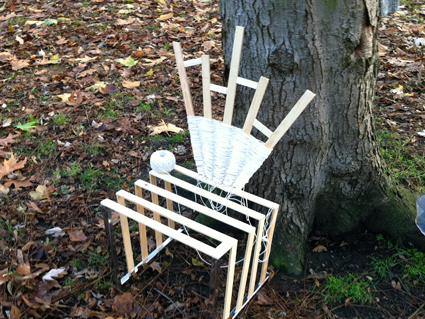
Making new from old… This is what some 130 Foundation students specialising in Design at Camberwell College of Arts were assigned to do, when using old pieces of furniture, taking them apart and using the pieces to create something new. Deconstructing is often the best way of finding out how  things are made, and with this brief students got the opportunity to experience first hand how to identify elements of design from the structural to the functional, how materials were combined and how the furniture was constructed.  While teaching them I for one got to refresh my memory on some technical jargon and certainly won’t be forgetting the difference between a dado and groove joint in a hurry! The whole project amounted to a cut and paste exercise in 3D, with making leading the design process.
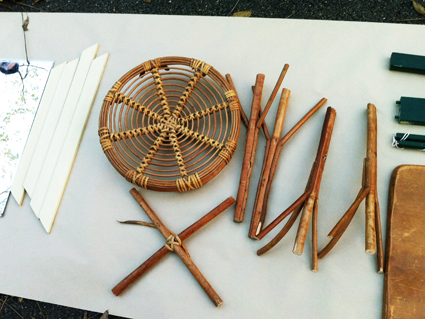


The best part, aside from the final display of outcomes illustrated below, was when students traded and exchanged parts during a bric-a-brac / flea market type event half way through the project.  Not everyone got what they wanted, some lost almost all they had brought, but with this new opportunities for thinking and making were made possible as an ad-hoc element was thrown into the brief.


The potential these works have lie in their open ended functionality: a constructed piece might become  a chair when positioned one way, a table when used on its side, or a piece of architecture when it's  turned upside down. Their practicality will ultimately be negotiated between the maker and the user. Meanwhile, the 3D workshop area with all its tools and equipment has become less of an alien environment for the students, a must for future designers.




Wednesday, 21 November 2012

exploding bird nests


Someone once described contemporary baskets as things that look like exploding bird nests.  It was meant as a criticism I believe but no matter, I love that image… 

Looking at a whole bunch of dailymades while still in the spirit of the first anniversary of the blog, I’ve put together the selection below with this in mind. There lies an idea for an exhibition... It needn’t be about contemporary basketry or even basketry art, but simply a sculpture show with works informed by the craft as well as a wider practice of weaving. Any interested curators out there?

pens, pencils and elastic bands
dailymade #120104
 
masking tape, paint and bristles
dailymade #120312
sycamore leaf stalks
dailymade #120613
paper clips
dailymade #120107
cardboard and clothes pegs
dailymade #120217
paper spills and wire
dailymade #120125
clothes pegs and card labels
dailymade #120808
paper and crayon
dailymade #120804
 
banana skin
dailymade #120309
orange peel and dental sticks
dailymade #120505
balsam poplar prunings and bamboo skewers
dailymade #120227

Friday, 16 November 2012

now we are one


Dailymades is 1 today! That’s 365 posts in the last year, one sculpture made everyday.  I’m surprised I’ve got this far with the project, and there’s no sign of stopping anytime soon either…

My aim, as with weeklyweaves, was to make sense of my interests in making and weaving with relation my own sculptures, installations and performance work. I aimed to make my practice a daily activity working with everyday materials and techniques.

From this a pattern of producing archetypal/symbolic shapes has emerged, circles for example, and making has become automatic, almost instinctive. Does it all make sense yet?  Yes and no. As with any research, one question leads to many more, and the answers (as well as inspiration to make more) are to be found amongst all of these.

dailymade #121108

One of my own personal favorite outcome meanwhile is the one illustrated above, produced last week and made from lollipops. Below is another survey, that of the 10 post popular posts since the blog began. Thank you for reading and following!

dailymade #120714

dailymade #120901

dailymade #120905

dailymade #120102

dailymade #120611

dailymade #111116

dailymade #111213

dailymade #120531

dailymade #120722

dailymade #111127

Tuesday, 30 October 2012

the secret of youth


Left my foraging ways behind in favour of urban forestry last weekend as I collected lime wood for making what I’m hoping will be a series of kinetic sculptures.  It will involve balancing wooden spirals (larger scale versions of the one pictured below) on an axis and have the wind spin them. More on this on a future post on this blog, meanwhile back to pruning, or rather pollarding…  


My good friend Marcelo, who I’ve worked with on the Weaving Time Machine sculptures helped me collect the wood that Jack (pictured up the tree) felled with his handy chain saw.  It was impressive to see him hoist himself up, make a few expert cuts, and see all these branches fall down all around us before hopping to the next tree.  We were kept really busy at ground level sawing, pruning and stacking the wood to make room for more branches to come down.  So much destruction, such a thrill… Spooky!


Pollarding makes trees live longer apparently and encourages new growth as their tops are not subjected to so much windage and weight.  Trees are effectively kept in a juvenile state. Fabiane, whose garden the limes we were in was complaining about the secretions from the trees spoiling the laundry she leave out to dry.  It sounds like in a couple of years' time the leafy teenagers will be giving her yet more trouble!  Still, on the upside, there will be plenty more lime tree blossoms to collect to make soothing infusions (linden tea), and sipping these rejuvenating brews, the sticky laundry won’t seem such a problem anymore I’m sure.


Sunday, 21 October 2012

land art / man made

A good work is the right thing in the right place
at the right time - Richard Long
dailymade #120905

Prompted by my recent foraging and weaving activities last week (see previous post) and a proposal I am working on at the moment for a show at the Nottingham Castle Museum and Art Gallery, I am looking at dailymades produced in the Calanques in Marseille six weeks ago. Reading Land Art  by Ben Tufnell at the time framed my thinking.  My concern was this: making a direct response to site and found materials through weaving and other related processes. Rather than expand on this, I’d like to let the images below and quotes from the land art masters themselves do the speaking.

dailymade #120901
dailymade #120913

‘One of the problems in sculpture is contact, the idea alone isn’t enough, it doesn’t work, an action is necessary. This action is transmitted through contact.’ - Giuseppe Penone

dailymade #120912
dailymade #120909
‘My art is a way of learning, in which instinct guides best.  It is all very physical – I need the shock of touch, the resistance of place, materials & weather, the earth as my source. It is a collaboration, a meeting point between my own and earth’s nature’ - Andy Goldsworthy

dailymade #120829
dailymade #120826

‘Work is not in the place, it is the place.’ - Michael Heizer