Thursday, 28 August 2014

Lace Tell @ Yan Tan Tethera


Time to retrace my steps a little…  A few months ago I was asked to contribute work for Yan Tan Tethera. Curated by David Littler in partnership with The English Folk Dance and Song Society, the exhibition looked at the connections between folk songs and textiles. My interest from the start was to focus not on songs, but dance. Thinking of it as a making process, I envisaged dancers working with yarn to produce stitches and knots, to be read as some form of dance score or notation - see previous post.


Fast forward to the present and with the help of a number of participants, I have now created four dances, a site specific installation and a series of objects and drawings that are currently on display in the exhibition. I'm now planning a final dance piece and to help with this, the following posts will reflect on what I've done so far.

With some of my previous installations such as Stairwell Weave-In in mind, I saw at Cecil Sharp House some potential to have performers sing as they stitched and stepped up the staircase, using the bannisters as a loom. During an early recce at the venue, David handed me a few songs from the EFDSS collection, including 'Lace Tell', a work song often sung by women while making lace.


The outcome resulted in 8 dancers working a single row of stitches each across three floors to the tune of this 'tell'. It was sung by 6 members of the Dulwich Folk and Cecil Sharp House choirs. Many thanks to Aimée Leonard, Sally Davies, Sarah Maddon, Jenny Tompson, Ian Kennedy and Sarah Lloyd for this. Over 20 minutes, the stairs gradually filled up with an audience as the stairwell filled with stitches. Two other dances were also performed that evening during Museum Night at Cecil Sharp House and I'll write about these in the next post. Read also more about this in Liz Hoggard's review of the show in Crafts Magazine September/October 2014 edition.


photo Roswitha Chesher


Thursday, 14 August 2014

the Matisse model


Seeing the Matisse cut-outs at Tate Modern was such an inspiration! I instantly got over stimulated and could hardly look at the works for wanting to get back to my studio and make my own collages. As a  result I now have a very sketchy memory of the show!

As it happens, I didn't get back to my studio that day to make a start on my own collages, but instead considered using the collage technique as an activity for one of the Meet me at the Albany Tuesday sessions. I knew that my friend, collaborator and colleague at Entelechy Arts, Zoe Gilmour had tried and tested collage with painted paper cut-outs at one of her own workshops, which encouraged me to pursue this for the planned activity.


My plan was to work large scale. With brushes and rollers attached to wooden sticks, participants painted paper on the floor while listening to live music, courtesy of pianist Arthur Lea and double bass player Ben Hazelton (Spitz Jazz Collective).  This worked a treat! Accompanied by the musicians, people danced and sang around the paper as they painted. Others cut the painted paper and, under their direction, I pinned them to a hanging fabric screen creating a large temporary mural.  A photographer from Arts Council England came to record the activity and if I get hold of some of these shots, I'll upload them on post here later. Too busy as usual to take any pictures myself.


What I enjoyed the most (apart from splashing paint around freely, which is always such a joy!) was to see how the act of painting became dance and movement, solo or in some kind of group formation. The idea of choreographing making is something I have been thinking a lot about recently, as I have been involved in choreographing dances for David Littler’s YanTan Tethera project and exhibition. I am now currently developing a fourth and final dance for the show to be performed on September 25th at Cecil Sharp House. More about this later. Meanwhile, merci Matisse!


Wednesday, 13 August 2014

Art - don't use!


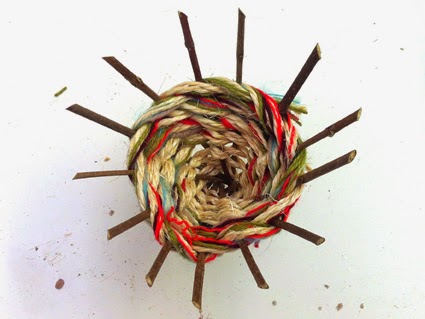
The Festival of Thrift instructible posted a couple of weeks ago on this blog, with instructions for twining with sticks and string, might have left you wondering what the object could be used for? Is it art? Is it design? If the Festival of Thrift is about celebrating upcycling and sustainable living, what is the point of making something that doesn’t have a function, no matter how green or economical the use of materials for its production are?

Well, art does fulfil a very basic human need and if you’ve made something, if only to look at, that is functional enough for me. The picture above is something I spotted outside the Czech Pavilion at the Venice Architecture Biennial a few days ago which, with humour, highlights this issue.

However, to put your sustainable minds at ease, I’ve turned the modernist principle of 'form follows function' on its head, and thought of a few uses for the original instructible…

·      fill the twined construction with seeds and nuts and use it as a birdfeeder
·      alternatively use it as a cover for a fat ball by threading and suspending the ball inside the cone 
·      use an apple instead of the a fat ball (see bottom picture) to feed your feathery friends, or use a pompom from which birds might pull threads and use in their nests for added warmth and comfort (see instructions below)
·      with a larger twined construction, use it as a hanging basket for plants by lining the inside with fabric or paper
·      finally, how about using it as a lampshade, using a low voltage bulb to prevent any fire hazard


Pompom making (a speedy method)


Wrap several yarns around your fingers, slightly spread.


Bring fingers together to release the bundle from your hand. Wrap the yarn tightly at least twice around its middle before tying and cutting off the yarn, 10 inches / 25cms approximately from the bundle - you'll be using this length to attach the pompom to the twined cone.


Cut the threads on either side of the bundle.


Fluff up and trim off the longer bits to make the pompom more regular.


Et voila!  Job done once again! 


For additional sources of inspiration on making bird-feeders and/or hanging baskets, click here and here.

Apple feeders for birds, better still with sunflower seeds
pushed into the fruits - click here for more pictures.

Monday, 11 August 2014

now we are one thousand!

Something unmade remains full of promise
and to celebrate the 1000th post on this blog,
today's Dailymade will not be made.

I posted the 1000th Dailymade today! It’ll be three years this October since I started http://dailymades.blogspot.co.uk.  If this project was higher education, I’d be close to graduating now. But what does my Dailymade ‘degree' qualify me for exactly? I started the blog to help me generate new work and prompt more reflection on my practice. Looking at what I've written here on weeklyweaves, this has worked very well. Am I to go on with this? Absolutely! It feels like I’m only just starting with this project, and as a three year old having just learned how to walk, I’m now eager to run.

Below are the 10 most visited Dailymades. It would make sense for me to post my own favourites here, but I think the choosing will be really hard. As I do feel I’m only as good as the last thing I’ve made, my own all time favourite has to be today’s Dailymade – see picture above. In this case of course it wasn't actually made and it goes to show that there maybe is only one thing better than making, and that is not to make!

Dailymade 120531
Dailymade 120712
Dailymade 120212
Dailymade 120713
Dailymade 120905
Dailymade 120901
Dailymade 121214
Dailymade 120611
Dailymade 130513
Dailymade 120102

Friday, 25 July 2014

ready steady weave (Festival of Thrift instructible)


Writing... at last!  It has been over three months since the last post on this blog, and weekly weaves has almost become quarterly weaves. That will no longer be however, though I have enjoyed the break. I will report on my recent creative endeavours in the next few weeks, of which there are many.  Meanwhile, here is an ‘instructible’ for a forthcoming project at the Festival of Thrift taking place this September in Darlington.


Commissioned through Home Live Art, the project involves creating an architecturally sized sculptural installation, stitched between trees and buildings at Lingfield Point.  The stitching will provide a framework for hanging woven objects made by visitors at the festival, using locally sourced natural materials and green waste combined with yarn.

The instructible below which should take about 5 to 10 minutes to make is one idea of several in development, for objects that could be produced by visitors to furnish the installation. The technique introduced here is twining, probably the oldest form of basketry and a skill related to what lead to the advent of the first baskets and buildings made by man. For more info see this previous post as well as others on this blog inspired by hedgerow basketry.

Whether the objects to be produced end up being templates for hanging baskets, bird feeders or  simply  decorations, the making of these by some of the 27,000 visitors expected at the festival (!) should be fun, entertaining, inspiring and bring home the fact that most of the stuff that surrounds you, including the growing varieties, can be used creatively. 

So, why not give it a go and come prepared to the festival by making one or several of these to add to the display.  There will be more instructibles posted here very soon. Keep your eyes peeled!


Recipe

To make a twined construction as those illustrated above, you’ll need 10/12 sticks, secateurs (optional), multi coloured string or yarn, an elastic band, a crochet hook (optional) and a pair of scissors.


Cut all the sticks to an equal length, approximately 12 inches / 30cm. Bundle them up using the elastic band making sure to arrange tips (thin ends) on one side and butts (fat ends) on the other. Try use sticks of similar thickness if you can.


Cut a 1/1.5m length of string/yarn. With the tips at the bottom, fold the length in half and loop over one stick as illustrated above. 


Bring the length of string on the right hand side of the stick over the front and loop over the back of the next one on its left. You are now twining!


Twine around all the sticks repeating this process.  These instructions by the way will mostly suit  left-handed people like me, that is twining round the bundle in a clockwise direction. If you are right handed, try reverse the direction you are working in, i.e. twining anti-clockwise.


Notice that as you twine the sticks will want to twist in one direction with the sticks coming apart.  Allow this to happen freely. The wider the gaps, the wider the opening of the 'basket' you are making will be. 


Notice also that one or several sticks will naturally find themselves in the middle as you have twined a full circle round the bundle. It’s up to you whether you want to weave these in by twining around them in between other sticks or remove them.


As the gaps get bigger, add more yarn as illustrated above to fill these in.


To finish, trim the yarn on the right hand side of the last stick have worked one inch from the weave.


Thread the remaining bunch underneath the last round of twining using a crochet hook if you have one. If not, prise the weave apart using fingers to hook the yarn through and trim 1 inch from the weave.


Last, cut the sticks at the top and bottom.


Et voila! Job done!

Sunday, 6 April 2014

bobbin lace or Circular Hey?


Can dance translate into weave? Can stitch become step? Some questions I’ve been pondering about while researching a current project I'm working on for the launch event of Yan Tan Tethera, on May 15th at Cecil Sharp House on the evening of May 15th. It's a project and exhibition curated by David Littler, in partnership with the English Folk Dance and Song Society (EFDSS), celebrating and exploring the connections between the making of textiles and song.

For my part, I’m aiming to create a number of dances based on folk songs and think of these as a making process with the outcome being a piece of fabric. My thinking is as much inspired by maypole as rapper sword dancing, where a resulting knot (or rose) is created by the interlacing of swords. The project will kick off with two exploratory workshops where a number of participants including myself will attempt to combine dance steps with stitch, knot and weave techniques. That is the plan so far and I can’t wait to kick up my heels with yarn and ribbons in my hands.

I’m still looking for participants by the way. The exploratory workshops will be on Thursday 10 April, 7-9pm and Sunday 13 April, 1.30-3.30pm at Cecil Sharp House in Camden. Please email me at mail@shanewaltener.com if you are interested.

Chiffon stitch of Straight Hey?