Showing posts with label bobbin dancing. Show all posts

Tuesday, 2 June 2015

All packed and ready to dance...

score for Bobbin Dance #5

Yan Tan Tethera is touring and I am getting ready for the curator of the exhibition David Littler to come and pick up the work which will be included in the exhibition at Walford Mills.


practice bobbins for Bobbin Dance #2

Pictured here are the various items that will be on show. All of these were used in dances performed last year at Cecil Sharp House where the exhibition was first hosted.


props for Bobbin Dance #4

Also pictured is the new score for Bobbin Dance #5, which will be performed for the opening of the exhibition as part of the Wimbourne Minster Folk Festival.


score and bobbins for Bobbin Dance #4 

I’m very happy to say Ben Moss who led the dances at the Folk Centre in London will be playing his fiddle for us again on June 13th when we ar to perform the dance on the streets of Wimbourne.


score and bobbins for Bobbin Dance #3 

Not included here are the drawings and pictures also to be exhibited in the show. I’m holding back on these for now, though if you look at the previous posts I wrote on Yan Tan Tethera you might just be able to work out what these will be. Better still, come see the show and join the dancers in the parade…

Jess wearing the new dance score, 
and packaged below

Friday, 29 August 2014

Bobbin Dancing @ Yan Tan Tethera (part 3/3)

'We discover performance by making it' 
- Goat Island performance ensemble

It’s fair to say Bobbin Dance #3 was a real challenge. With fewer dancers available, each of us danced with two bobbins instead of one. Given the complexities of working with these (i.e. winding and unwinding pairs of bobbins in time with the music) and the limited number of rehearsals scheduled, this was probably not the wisest of choices.

The dance was performed in the garden, starting this time dancing a straight hey around two rows of fencing pins, from one end to the other using sticks only. We then 'upgraded' to wooden bobbins with ribbon, and five of us proceeded to weave something close to a 'fond the torchon' stitch with our 10 bobbins, accompanied by Ben Moss on the fiddle. Sketches used as scores in the previous dances (see previous post) seemed ineffective when holding two bobbins each, so I drew up the score below.


In comparison with the two previous dances, this one seemed to be more about the handling of the bobbins and less about dancing. We forgot about our bodies and how we moved as we grappled with the mechanics of handling the bobbins and ribbons.

photo Fay McNulty
photo Faye McNulty

So where to go from here? What elements of the dances should be reworked, cut back or explored further? Should we maybe dance without thread and bobbins? Might we present the work as an installation instead of a performance and show the weaving of the piece as film (the do-si-do, passing by right and left, figures of eight, circular and straight heys, turns and crosses, fond the torchon, Brussels stitch)? Should the performance be more of a durational work, allowing more ‘fabric’ to be woven as suggested by one of the dancers? Should the music follow the sound of the bobbins rather than leading them?


So many questions needing answers... As the work was developed with the dancers, I'll now put these questions to them. I doubt we’ll reach a consensus, but we’ll then be in a better position to proceed with making informed decisions for the final performance and event of Yan Tan Tethera.  Will keep you posted on this...


Meanwhile I'll seize here the opportunity here to thank again to all the bobbin dancers who helped make this work possible. They are Chloe Metcalfe, Jess Smulders-Cohen, Julia Manheim, Odette O’Reilly, Pallavi Jain, Ruth Bradshaw, Tina Götschi, Vanessa Trotter, Vicky Harrison, Weiyee Cheung and Zoë Gilmour. A special thank you also goes to Ben Moss and Aimée Leonard for providing the music and their encouragement throughout, as well as singers from the Cecil Sharp and Dulwich Folk choirs.


Bobbin Dancing @ Yan Tan Tethera (part 2/3)


When dancing around the Maypole, ribbons wrap around its length from the top down to create the 'weave'. When making bobbin lace, stitches are spaced out using pins on a pillow. Both the pole and the pins and pillow allow the weaving and lace making to grow. Dancing with only bobbins offers no such luxury; only a limited number of 'turns' and 'crosses' (see previous post) can be made before the threads twist over each other and the pattern disappears.


The question was then how to make the dance long enough to match the duration of the song we would be dancing to.  We explored various ways of doing this. We switched from using bobbins with fixed lengths of rope to using bobbins with handmade ribbon, the length of which could be unwound at will, allowing us to travel away from and extend the weave. This offered many more possibilities and resulted in two dances being created.


Following the performance of a circular hey, also described in the previous post, Bobbin Dance #1 split dancers into two groups of four. Stepping in opposite directions and now performing something close to a straight hey, the dancers wove their bobbins to the tune of Off Jumps Jack and Yan Tan Tethera, sung by the Cecil Sharp House and Dulwich Folk choirs. This a created a four-way plait worked simultaneously in both directions.
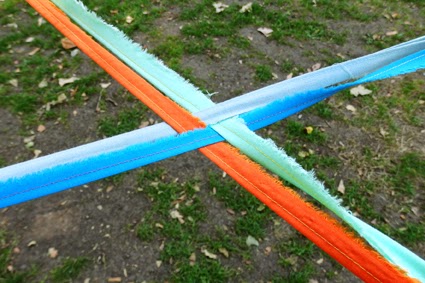

In Bobbin Dance #2, six dancers all stepped in the same direction, 'turning' and 'crossing' their bobbins and eventually weaving around two rows of singers performing do si dos and straight heys. The dance floor became a 'lace pillow' (with  the singers as ‘pins’) onto which a network of knots was created.

photo Fay McNulty
photo Faye McNulty
photo Fay McNulty

To rehearse the dances, various scores were produced to help memorise the moves, as illustrated below. More on this and Bobbin Dance #3 in my next post on this blog.