Monday, 17 June 2013

studio surfing


If process is everything, then where better to see work than in the artist studio. Paying a visit last week to Helen Carnac and David Gates in both their work spaces, I was once again impressed to see how the combination of materials, tools and works in progress make such a cohesive and aesthetic whole. It reveals something fundamental about their practice; I only wish I could say the same about my own studio!


Occupying adjoining spaces in an old manufacturing building in south-east London, their studios are full of stuff in a state of productive messiness, seemingly random arrangements of things making you question whether they’ve been placed with specific intent or not. I know of course that details here are all important, and it's fascinating to see how these ad-hoc juxtapositions, these accidental montages, end up finding their way into the work they each produce.  


There is some kind of ‘cross-pollination’ happening between the two studios, a conversational exchange between one space and the other. Having worked with Helen and David on a number of projects, I am familiar with much of what I see here. What I’ve photographed however is also resonant with ideas addressed in my own work; I have captured what I know and recognise in my own practice. Could these photographs be evidence some kind of melding all of our work?


I've often wondered what the outcome would be if artists swapped studios for a period of time. In this case I would use David’s woodworking tools, David try his hand at enameling, and Helen work with my secateurs, lace bobbins and crochet hooks. I can't imagine David trusting me to go anywhere near his hand tools, so we'll never know the outcome of this, but these pictures, showing detailed views of both David and Helen work spaces, go some way I think in giving me a sense of what would happen with this imagined 'studio surfing' scheme.


Friday, 14 June 2013

lost in lace


Inspiration lies only round the corner. While in the process of developing my forthcoming installation at the Nottingham Castle Museum (see previous post), I now see now lace patterns everywhere! Here are some examples, alongside actual lace patterns.


This project is truly taking me on a new path of discovery, but might it also drive me round the bend?  No matter, I'm loving being lost in lace in the meanwhile!


Sunday, 9 June 2013

knots for Notts


I spent two glorious days in the sun the week before last in the grounds of Nottingham Castle, overlooking the city and rehearsing the making of my next installation for the museum’s forthcoming exhibition Make Believe: re-imagining history and landscape.


The city’s history and connection with lace making informed my contribution to the exhibition: a large scale lace installation created on the lawn around the castle using fencing pins and rope. Helped by three assistants and a group of enthusiastic volunteers, we rehearsed the making of the piece by using our fingers and hands to stitch between trees. We then proceeded to do something close to formation dancing, acting as human bobbins, holding lengths of yarn and winding these around the (metal fencing) pins as you would on a lace pillow. Click here for footage of the rehearsal on the Fermynwoods Contemporary Art website.


Many possibilities and challenges were revealed as we worked and talked about what we were doing and at the end of the two days, I came away from from the activity with a head full of ideas which I’m now processing. I’ve now ordered nearly two hundred fencing pins and can’t wait for the next time I am up there with this lovely group.


Thanks so much to all the volunteers who helped rehearsing the piece, and to my assistants Jess, Sarah and Rossella.  You were all great!


Thursday, 2 May 2013

forró casino: human knitting


Compare and contrast... The top image was taken practicing Forró Casino at the Forró Festival in London last weekend. Images below are of one of my knitting pieces exhibited at the Crafts Council, part of their Knit 2 Together exhibition, and instructions for a country dance below.  

All are of forms of knitting of one kind or another. It goes to show knitting isn’t all about yarn, nor making all about about materials!

Knitting Piece #9 - Crafts Council, London

illustration published in The Country Dance Book,
Cecil J. Sharp, EP Publishing.


Saturday, 27 April 2013

cobwebs in the museum


Earlier this month I re-installed Another World Wide Web at the Powerhouse Museum in Sydney.  Originally installed in 2011 for the Love Lace exhibition, the piece was taken down while the museum underwent some major refurbishment.

The piece, knitted using shirring elastic, was stretched across a different space this time, adjacent to the site of the original installation. As a result, the shape of the new space informed a very different configuration.

There is talk of the show travelling to a soon-to-open, designed by one of Britain’s leading architects. This being unconfirmed, I can’t disclose the location yet, but given this London-based Iraqi  architect’s interest in overlapping perspectives and parallax, installing the piece in this new building should be a real adventure.  Fingers crossed that the plans for the show to tour are realised!

For more details on this installation and other related works, click here and here and here.


Friday, 26 April 2013

nature | maker

lace trim

Let’s take a pause, sit back, relax… Rather than getting on with making things and getting busy with my Dailymades, I’ve simply tuned in to all the stuff being made and transformed all around me.

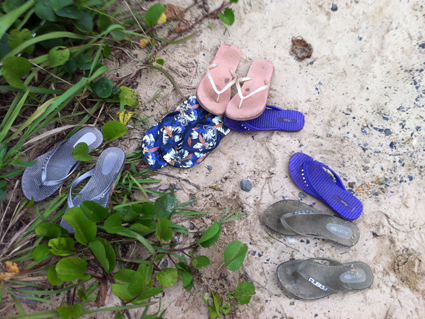
Below is a record of what was made (and displayed) on a beach in northern New South Wales over the course of the last few days. Not doing anything can be the best way of achieving something...

tapestry

embroidery

pattern

map

score

stepping and stopping

hopping off


Friday, 22 March 2013

mapping memories


Done and dusted, almost! I finally sent off the retouched, reworked, resized, highlighted, airbrushed, copied and proofed artwork for printing yesterday. In a month from now I should be getting the composite image made from 52 photographs, printed on 3 sheets of formica. These will then be bonded onto three table tops furnishing a common room at the Lewisham Hospital. This will be the culmination of my involvement in the Little Boxes of Memories project, led by Entelechy Arts in partnership with the Museum of London and the hospital. See previous post art for health: remembering and forgetting for more writing on this.


The design was inspired by stories of four participants I worked with at the hospital. A patchwork of words, images, flowers, objects and materials all collaged together, it maps out their personal accounts of London and other places. The design weaves elements of interconnected narratives and memories of celebration, hope, love, loss, travel, passions, transformation and change, aiming to prompt further sharing and reflection amongst visitors and patients.


Thursday, 21 March 2013

the new age of Wicca


Earlier this month the creative agency Wicca re-launched their website, showcasing a new extended stable of artists. It was great to see the range of works featured in each of the artist’s portfolios, and also the selection of images chosen by Wicca of my own work. What all their artists have in common is a strong foundation in craft and making, whether specialists in 3D production, art direction, design or illustration. It was a treat to read the bio they wrote about me, not least because for once I didn’t have to write the copy myself.  So, blatantly indulging myself, I'll share it with you below:


Weaving, Basketry, Material ‘Hacking’

Shane's work draws inspiration from craft traditions and processes. This sees him create visual narratives using materials and skill-sets as varied as needlepoint, basketry, weaving and sugar craft. A true expert in the field of craft practices, Shane can take everyday objects, and the simplest of materials and 'hacks' them to create the visually spectacular. 


At its core Shane's work is rooted in ideas of ecology and the reuse and recycling of material. His fluency with materials and processes allow him to play with scale in his work, from enormous pieces covering the central atrium of the V&A to smaller scale experiments with grasses, sugar and balloons. Shane has exhibited work worldwide. He lives and works in London. 


Clients include: Jupiter Artland, Scotland, Museum of Arts and Design, New York, Swarovski, Scottsdale Museum of Contemporary Art, Arizona, Powerhouse Museum, Sydney, Federation Square, Melbourne, Sydney Design 2011, Royal Shakespeare Theatre, Stratford-Upon-Avon, Bloomsbury Publishing, Nottingham Castle Museum and Art Gallery, Dovecot Studios, Edinburgh, Siobhan Davies

Needless to say I am really looking forward to working with them. For more info on the agency and Wicca artists, click here.


Monday, 4 March 2013

flights of fancy


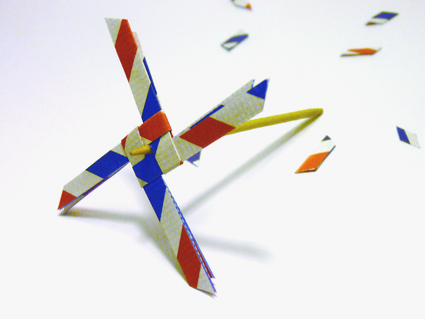
While sourcing materials to produce artwork for a commission at the Lewisham Hospital, I was very happy to see that when I searched for suppliers of chevron border envelopes, three of the four images that first came up were of my dailymades.


I have repeatedly been drawn to working with patterned envelope papers over the years. I used them as early as 2002 in a sound installation for Danielle Arnaud at the Museum of Garden History, and in another sound piece created for my first solo exhibition at MK gallery in Rotterdam. I have included  them since in the graphics on my website, and I like to think that I possibly have the largest collection of patterned envelope papers in the world.  Entering the collection in the Guinness Book of Records has been on my to do list for over a decade now and writing this will, hopefully, prompt me to do something about it.


Amongst all the envelopes in my collection, there is something I find particularly compelling about the chevron border airmail envelopes; they travel faster and longer distances than other envelopes, criss-crossing the globe like migratory birds, and weighing no more than some of these avian species either. In an age where most correspondence is done via email, chevron bordered envelopes convey a sense of romance and the exotic. Though cheap, readily available and instantly recognisable, they are full of the promise of distant places. For me, this sums up their enduring appeal...