Showing posts with label assemblage. Show all posts

Saturday, 30 June 2012

sycamore is for curiosity


Sycamore (Acer pseudoplatanus) grows like a weed in London.  You’ll find it sprouting all over the city alongside fences, railings and buildings. Any bit of unattended ground is an ideal home for this opportunistic plant and with all the rain we’ve had in recent weeks, what were small shoots a while back now amount to small woodland areas.  This is the case near my studio, where I’ve gone out to collect some equipped with a saw and pair of loppers. Who am I to turn down free materials?


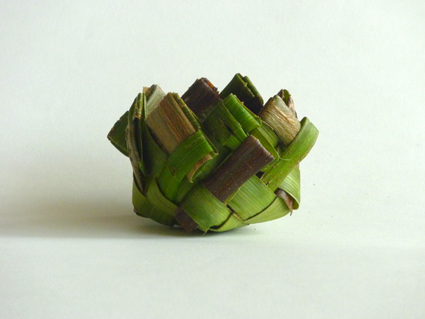
The aim was to strip the bark off the wood collected and use it for plaiting and weaving.  So far I’ve used every part of the tree but the leaves, so these trees haven’t been felled in vain. If I was making garments, this approach would be equivalent to zero waste pattern cutting. All this has led to really interesting experimentation.  I’ve assembled, plaited, coiled and twined the leaf stalks to make nest like constructions and baskets.  I’ve bent, split and joined freshly stripped branches to make bowl and plate shaped recipients.  I’ll be working with the leaves next, so keep your eyes peeled on this coming week’s dailymades. I was only looking at an old catalogue of Andy Goldsworthy the other day. Such inspiration… If anyone knows how to work with leaves, he does!

stripped and bent sycamore

sycamore leaf stalks and branches

I’ve yet to find out what will come of all this work I’ve done: the development of new products, fresh ideas and approaches for making sculptures, new activities to be practiced in future collaborative projects… It’s too early to say, but I’ve realised there is something fundamental about working with trees.  It has something to do about connection you’re making with the environment. Phil Macnaghten writes eloquently in his short essay on trees in Patterned Ground: Entanglements of Nature and Culture, about their ‘dynamic temporality’, their ‘contribution to a sense of place’, and their relationship with people being historically ‘intimate and productive, reflected in customs of hunting, foraging, burning, beekeeping, building, grazing, and so on…’.  He also says trees ‘exhibit a rhythmic pattern of persistence and change, from the swaying, bending and twisting of branches, to the growth of leaves and ripening of fruit, to eventual death and decay.  Trees embody an intergenerational model of time’.  It is possibly this idea of time that has drawn me in, something that is of course pertinent to making, and weaving in particular.

sycamore leaf stalks

plaited and coiled sycamore leaf stalks

sycamore seeds, leaf stalks and bindweed

Foraging for sycamore has left me wanting to know much more than simply weaving with bark, so it is no surprise to find out that the symbolic meaning of sycamore is curiosity.

sycamore bark

Saturday, 7 January 2012

stationery hacks: assembled baskets


There’s a flurry of activities at the studio at the moment as I am preparing for two new shows opening next week. One is at Siobhan Davies Studios (more info on this in my next post), the other a group exhibition of staff teaching on textiles and jewellery courses at Morley College. The college is a long established adult education centre near Waterloo. I have been teaching there for over ten year now, less than 10 days a year on average, but I love it. The age of my learners ranges from 18 to 80, and the breadth of experience amongst the group makes for the most interesting sessions.

The college has a gallery and it is in this space that I will be exhibiting. Their last show which I didn’t spend enough time at was on the influence of Cornelius Cardew, who taught an experimental music class at the college in the 60s, amongst a list of other illustrious figures such Gustav Holst and Benjamin Britten.

My contribution to the exhibition will consist of three assembled baskets. Made out of pencils, felt tips and biros, each of these were constructed on a piece of A4 paper and have thus produced a drawing each, a record of their own creation. I will be exhibiting these alongside the baskets. I produced a similar piece last year that was included in the assembled basketry chapter of Practical Basketry Techniques (pg 140), and was inspiration for the two assembly projects illustrated in the book. Outcomes of these are posted below.


Monday, 2 January 2012

ad hoc doilies


The Crafts Council approached me the week before Xmas asking me to submit a piece for their collection. Rather than choose something I had already made, I thought I’d develop a new piece for them. Knowing they are interested in adding to their textile collection, I thought I’d make use of my knowledge of lace making and combine this with some assemblage processes using materials I have at hand at the studio. After a few days work, I ended up working out how to make doilies out of paper clips. Useless if used as they are meant to be - it will be the doily not the pot that will scratch the surface of your precious piece of furniture - they are simply to be appreciated for their aesthetic value…

To make these, I reinterpreted bobbin lace making technique to suit working with the clips - I've used a wooden board and nails instead of a pillow and pins to do this. Thinking about it now, I had in mind the work of Joep Verhoeven who I met during the Sydney Design Festival last August, when exhibiting in the Love Lace exhibition. Joep create architectural sized pieces using bobbin lace technique and wire much in the same way I have with hammer, nails and a jig. I love this misappropriation and reinvention with processes and materials. To understand something better, you often have to step away from it to take a fresher look at it, and in this way allow for innovation.

I relied on this strategy when working on the Hybrid Basketry project at Origin Craft Fair in 2009, which resulted in the commissioning of the Practical Basketry Techniques publication mentioned in an earlier post. Visitors at the fair were asked to deconstruct a basket in order to remake something, and in doing so, find something out about basketry and related techniques of making.

This ‘hybrid’ a approach to making, and the notion of re-using, appropriation, or even ‘hacking’, is nothing new of course. It has been a characteristic of design and art practice for 20 years at least. Designers such as Ron Arad and Jasper Morrison took up the ready made cause in the early 90s. Re-use and re-make ethics were promoted by Tom Dixon as well as Renny Ramakers and Gijs Bakker from Droog Design amongst many others. Choosing to re-use, whether out of necessity or not, teaches you to be resourceful. The theorist Charles Jencks coined the term ‘Adhocism’ in the 60s to describe “using an available system or dealing with and existing situation in a new way to solve a problem quickly and efficiently…a method of creation relying particularly on resources which are ready to hand”. I have a slight regret that this way of thinking was not featured more heavily in projects for the book mentioned above. No matter, the beauty of collaboration (co-authorship in this case) is the opportunity to find out something new and be surprised at the resulting outcome of your joint efforts.